
Greenback falls 1.4% against major currencies as investors pivot on rising US policy risk
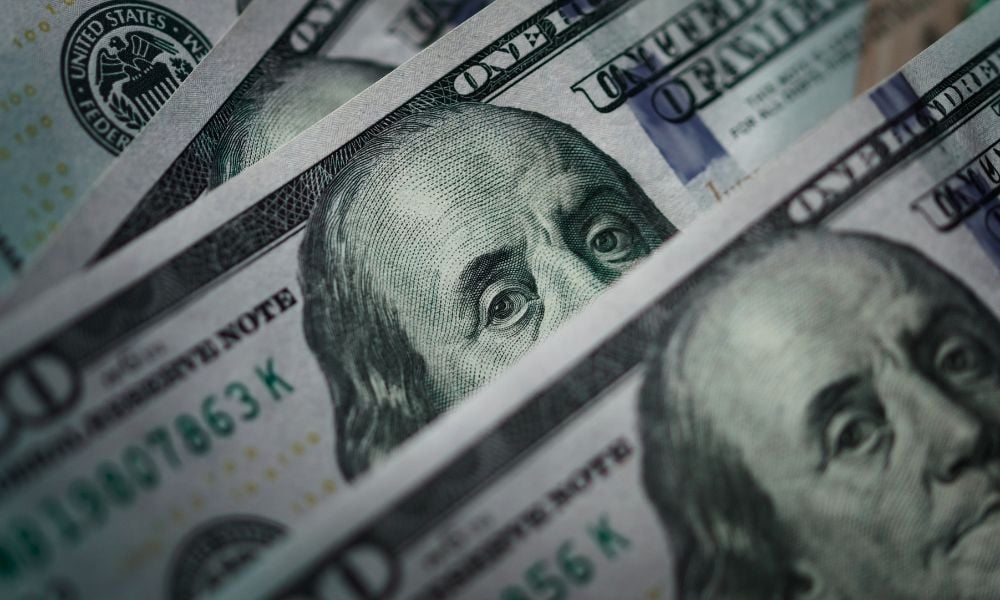
The US dollar is sliding, and global markets are trading that weakness hard.
According to Reuters, the greenback fell 1.4 percent against a basket of currencies to 95.77, its lowest level since February 2022, after US President Donald Trump said the dollar’s value is “great” when asked if it had dropped too much.
RMarc Chandler at Bannockburn Capital Markets sees the remark as a signal that the US “would prefer a weaker dollar,” and said “the market is happy to give it to them.”
Analysts link the dollar’s decline to Trump’s policymaking, questions around US Federal Reserve independence and rising talk of direct currency intervention.
Jonas Goltermann at Capital Economics wrote that “while there are several potential culprits for the dollar’s drop, the main driver is the fallout from reports that the US Treasury is considering direct currency intervention.”
The weakness is broad.
Reuters said the euro rose 1.4 percent to US$1.20375, trading above US$1.20 for the first time since June 2021, while sterling gained 1.2 percent to US$1.3844, its strongest since September 2021.
Japan’s yen sits at the centre of intervention speculation.
The yen rallied as much as 4 percent over two sessions on talk of US‑Japan rate checks, often seen as a precursor to intervention, pushing dollar/yen briefly below 153 before it last traded around 152.23.
A person familiar with the matter said the New York Federal Reserve checked dollar/yen levels with dealers, while Japanese authorities said they were in “close coordination” with the US on foreign exchange.
Policy uncertainty is amplifying the move.
Karl Schamotta at Corpay in Toronto said economic policy uncertainty is rising as the “‘tariff man’ shows no sign of repentance” and the US government heads toward another shutdown, fuelling the “‘Sell America’ trade.” He added that “no one is willing to catch the falling chainsaw that is the US dollar.”
Trade tension adds another layer of risk.
Reuters reported that Trump accused South Korea’s legislature of “not living up” to its trade deal with Washington and said he would raise tariffs on imports such as autos, lumber and pharmaceuticals from Asia’s fourth‑largest economy to 25 percent.
He also said he would impose a 100 percent tariff on Canada if it follows through on a trade deal with China.
Monetary policy sits in the background of all this.
Investors widely expect the US Federal Reserve to hold rates unchanged at its current meeting.
Nick Rees at Monex told Reuters that “the big risk, as we see it, is not in the rate decision. We’re pretty confident that the Fed is going to hold rates unchanged. But Trump is not going to like that.”
Trump has been urging the Fed to cut rates and could announce his candidate to replace Jerome Powell soon after the decision.
Bloomberg reported that investors in the roughly US$30tn US Treasury market have positioned for an extended pause, with swap markets pointing to the next cut in July and another possible move later in the year.
TD Securities strategists told Bloomberg there is now a higher bar to justify cuts and said that while this meeting is unlikely to drive the dollar, their bias is “to sell into any USD rallies.”
A weaker dollar is feeding directly into hard assets.
Gold climbed above US$5,200 an ounce to a record, up about 20 percent since the start of the year after breaking US$5,000 for the first time this week. Silver has gained more than 50 percent over the same period.
Despite the policy noise, equity markets remain resilient.
Bloomberg said the S&P 500 rose 0.4 percent toward 7,000, with almost 80 percent of companies that have reported so far beating earnings estimates.
In Asia, the MSCI Asia Pacific Index gained 0.7 percent to a fresh all‑time high, led by technology and memory makers such as SK Hynix Inc.
For longer‑horizon investors, the currency angle is critical.
In an interview with Bloomberg TV, Rob Kaplan, vice‑chair at Goldman Sachs Group Inc., noted that the US carries about US$39tn of debt and said “stability of the currency trumps exports.”
He added that “the US is going to want to see a stable dollar and wants to see stability, and wants to be able to sell the long end of the Treasury curve. A stable dollar helps.”


