
Canadian economy sheds 83,900 jobs as oil shock and housing slump test policy pause
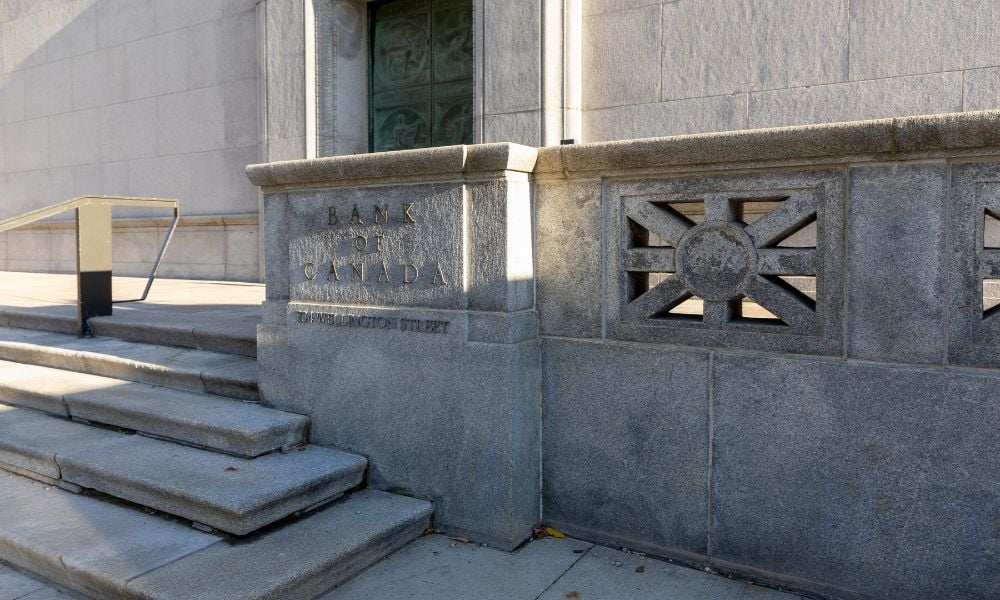
Oil prices are surging, growth and jobs are weakening and housing is soft, yet the Bank of Canada is still expected to keep its key interest rate unchanged at 2.25 percent this week.
According to Bloomberg, economists it surveyed are unanimous that Governor Tiff Macklem and the governing council will hold the policy rate at 2.25 percent for a third straight meeting, which also matches market expectations.
The Wall Street Journal reports that all 12 economists it surveyed last week also expect no change and that most see a “good chance” the Bank of Canada stays on the sidelines for all of 2026 because of broad-based economic weakness.
The Financial Post says economists expect the overnight rate to remain at 2.25 percent, with some believing the current pause will last longer even as markets price in an increase in the second half of the year.
Oil and gasoline prices sit at the centre of the dilemma.
Bloomberg reports that the bank’s January forecasts for growth and inflation assumed a Brent crude price of US$60 per barrel, but the benchmark traded at about $102 on Tuesday after the war in the Middle East and attacks on Iran by the US and Israel.
Domestically, gasoline prices have already climbed more than 30 percent this year to the highest level since 2024, according to Bloomberg, while the Canadian Automobile Association told The Wall Street Journal gas prices are roughly 30 percent higher than a month ago.
Economists cited by The Wall Street Journal say headline inflation is likely headed toward 3 percent in the coming months once higher fuel prices feed through the economy, and warn that inflation expectations among households and firms could rise.
Bloomberg notes that consumer inflation expectations are strongly correlated with gasoline prices and that memories of the 2022 inflation spike and rapid rate hikes remain fresh.
At the same time, growth and labour data point to mounting slack.
The economy contracted at a 0.6 percent annualized rate in the fourth quarter of 2025 amid slowing population growth and trade war damage.
Canada shed 83,900 jobs in February, the biggest monthly decline in four years, Bloomberg says, with steel, aluminium and auto exports to the US crimped by duties.
Housing resales are weak, prices are falling in a number of regions and condo markets in the largest cities are in a “full-blown correction.”
The Wall Street Journal adds that employment fell in the first two months of 2026, with February’s decline the biggest since early 2009 outside the COVID-19 period and concentrated in full-time private-sector jobs, leaving “spare capacity in the economy.”
It also reports that the three‑month annualized average of the Bank of Canada’s preferred core inflation measures eased to 1 percent in February, a 13‑year low, while total inflation decelerated to 1.8 percent.
Economists quoted across the excerpts say this mix justifies caution.
Claire Fan and Nathan Janzen of Royal Bank of Canada wrote that “the Bank of Canada won’t rush to respond without clarity on size and duration of the oil price shock.”
Doug Porter at BMO Financial Group told the Financial Post that “ongoing trade uncertainty and fresh conflict-driven unknowns” both point to a “policy pause,” arguing that a rate hike this year would be “an extraordinarily bad policy decision.”
Avery Shenfeld at CIBC Capital Markets said in the Financial Post there is enough slack to prevent a short-lived oil shock from spilling over into core prices.
Taylor Schleich at National Bank Financial told The Wall Street Journal that spare capacity makes it easier to “look through incoming inflation” and that, without surging oil prices, markets would likely be close to fully pricing a 2026 rate cut.
Still, some see a risk that higher oil forces the bank’s hand.
Deputy governor Sharon Kozicki said supply-side shocks might compel higher rates even in a struggling economy, though increases could be more modest than in a demand boom.
Sébastien Mc Mahon at iA Global Asset Management told The Wall Street Journal the bank could lean on forward guidance to reinforce its 2 percent target and said rate increases by the end of 2026 are likely if oil stays above $95 a barrel for most of the year.
According to Bloomberg, David Doyle at Macquarie Group expects forward guidance to turn “slightly hawkish” versus January due to higher oil prices, without signalling a rate increase.
Robert Both at TD Securities told The Wall Street Journal the bank will acknowledge fresh inflation risks but is not expected to lean towards rate hikes.
Market pricing and financial conditions have already shifted.
Bloomberg reports that Canada’s sovereign yield curve has steepened since the conflict began, tightening financial conditions, with the five‑year yield – a key measure for mortgage rates – up about 30 basis points since the bombing started.
Swap markets still price about 25 basis points of rate increases by year‑end even as recent data show the Canadian economy losing the most jobs in more than four years and inflation slowing more than expected.
The Canadian dollar reflects this push and pull.
Bloomberg notes that the loonie, one of the most resilient currencies in early March, has since lost its edge.
It is little changed around 1.37 per US$1 this week and down about 0.4 percent against the US dollar this month.
Strategists at Deutsche Bank, BMO Capital Markets, Morgan Stanley and JPMorgan, cited by Bloomberg, expect the loonie could weaken further if the Bank of Canada strikes a more growth‑focused tone or if investors turn more neutral on rates.
However, Brown Brothers Harriman’s Elias Haddad argues the currency is better positioned than those of heavy oil importers like Japan and India if the conflict results in a prolonged hit to energy supply.
Trade tensions add another layer.
In January, Macklem said the era of open, rules‑based trade with the US was “over,” and nearly three‑quarters of Bloomberg’s survey respondents agreed.
Bloomberg reports that US duties have already hurt steel, aluminium and auto exports.
The Financial Post says CUSMA renegotiation is a major uncertainty, with scenarios that range from aggressive rate cuts in a worst case where the agreement ends to a “quick and painless” new deal that could unleash pent‑up investment and hiring.
Porter told the Financial Post he expects talks to be “bumpy,” noting that Canada is among dozens of countries swept up in US investigations into forced labour.


