
After years of disruption, Canada’s real estate market is sorting itself by durability. Paul Chin explains how Centurion built insulation before the cycle turned

Real estate markets tend to reveal their true character only under pressure. Long periods of growth can mask weak assumptions, excessive leverage, and fragile business models. Periods of disruption do the opposite. They surface what holds and what does not.
Over the past several years, Canadian real estate has been forced into that kind of reckoning, confronted by higher interest rates, geopolitical uncertainty, government policy (including immigration and tax), shifting work patterns, and rising construction costs all at once. What has emerged is not a market in retreat, but one sorting itself by durability.
Well-positioned to assess that distinction is Paul Chin, Chief Investment Officer at Centurion Asset Management Inc. (Centurion). With over three decades in institutional real estate finance, Chin has worked across life insurance portfolios, pension capital, securitized lending platforms, and cross-border investment strategies. His career includes senior roles with organizations such as CIBC, Colliers, HBOS Canada, and, most recently, Otera Capital, the global real estate lending arm of La Caisse, where he served as Chief Investment Officer and helped expand the platform into the U.S., U.K., and Australia. Today, as part of Centurion’s leadership team, Chin brings that institutional lens to a market and asset class he believes has proven more resilient than many expected, though not without meaningful change.
Chin notes real estate is cyclical and is resetting due to current market fundamentals. In his view, the last few years have challenged Canadian real estate but not all asset classes have been impacted in a similar way, and the sector as a whole has demonstrated its resilience.
A market on pause, shaped by uncertainty rather than distress
In Chin’s assessment, the defining feature of the current cycle is not distress but a pause and reset created by market volatility and evolving fundamentals. The rapid rise in interest rates, combined with inflationary pressure and geopolitical instability, has created an environment where capital is cautious rather than absent.
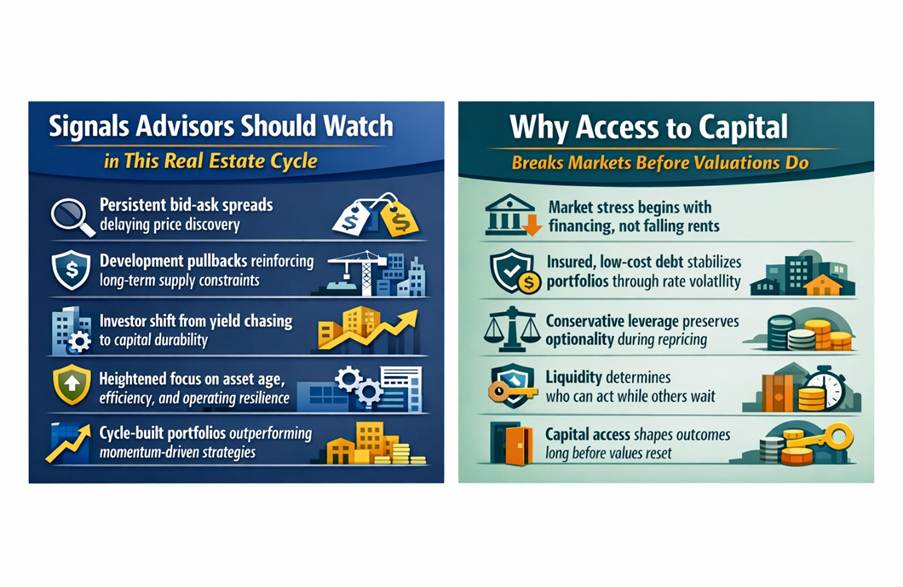
“The reality is that we’re seeing a pause,” Chin explains, “not a collapse.” Transaction volumes across most asset classes have slowed sharply, driven by widening bid-ask spreads and difficulty aligning on price. Cap rates, which tend to lag movements in bond yields by several months, are still adjusting.
“No one has really called the bottom yet,” he says. “There’s still a disconnect between bid and ask. And in an environment of uncertainty and volatility, there tends to be a flight to quality, safety, and an increased focus on what can be controlled.”
What investors can control, increasingly, is cash flow and operations. With borrowing costs elevated, the appeal of speculative appreciation has diminished. Stability and quality have moved to the forefront. That shift has exposed meaningful differences between asset classes.
Office, in particular, remains in transition. Chin avoids sweeping judgments. Well-located, new office buildings continue to perform, especially as more employers push for increased in-office presence. In some cases, tenants that downsized too aggressively during the pandemic are now reassessing their space needs.
“At the top end, quality still matters,” Chin says. “Companies trying to attract and retain talent want the best space available.”
At the same time, uncertainty persists around the long-term implications of hybrid work and technology. Lower-quality older office stock faces a more difficult adjustment, especially in markets where vacancy remains elevated.
Multifamily and student housing tell a different story. There, Chin sees fundamentals that have not merely endured but tightened. With homeownership increasingly out of reach, Canada will continue to see significant structural growth in rental housing demand. However, supply has been structurally constrained.
“That gap doesn’t close itself,” Chin says. “And when you layer on higher construction costs, required skilled labour, financing costs, and regulatory delays, new supply becomes very difficult to justify.” This continues to support strong long-term fundamentals in the purpose built multifamily market.
Student housing follows a similar logic, particularly when assets are located near major universities. Proximity, amenities, and community programming have become central to demand. While policy changes have affected international student flows, Chin views the long-term outlook for purpose-built student housing in close proximity to major universities as stable.
The major universities remain critical to Canada’s growth strategy. And the locations that serve them will tend to be resilient.
Why Canada has absorbed the shock
Beyond individual property types, Chin points to structural features that have helped Canada absorb recent shocks. A significant portion of commercial real estate is owned by pension funds, well capitalized REITs , and other institutional quality owners. Overall lending standards have remained conservative and combined with regulatory oversight has limited speculative excess.
Canadian banks have been disciplined. That helps prevent overbuilding and excessive leverage. It’s not flashy, but it matters when conditions tighten.
Canada’s broader institutional framework has also played a role. A stable political system, strong rule of law, and a well-capitalized banking sector have long underpinned its reputation as a safe haven. During periods of global disruption, those qualities become more visible.
“We’re not immune to what’s happening globally,” Chin says. “But relative to many markets, Canada compares very well. And when uncertainty rises, that relative stability starts to attract attention.”
He has seen that shift firsthand. International investors reassessing exposure to Europe or the United States have begun to look more closely at Canada, particularly for strategies centered on durable income rather than aggressive growth.
“Housing is something they understand,” Chin says. “They understand the supply-demand imbalance, the affordability challenges, and the role it plays in the broader economy.”
Building for durability, not just growth
Resilience, however, is not just about asset selection. It is also about how portfolios are financed and operated. At Centurion, Chin emphasizes that insulation came from decisions made well before the market turned.
“We’ve taken a very conservative approach to leverage,” he says. “That matters more than people realize when conditions change.”
Centurion’s portfolio operates at roughly 43 percent loan-to-value, below what many would consider typical for a core-plus strategy. That restraint provides flexibility when refinancing conditions tighten and limits forced decision-making. Just as important is the nature of the debt itself. For purpose-built multifamily assets, Centurion’s team has utilized CMHC-insured financing.
“That access to CMHC-insured debt helps to stabilize the portfolio,” Chin says. “It gives you the lowest source of capital at almost any point in the cycle. And when markets are disrupted, access to capital is one of the first things to be impacted.”
That emphasis on capital durability extends to asset design and age. Roughly two-thirds of Centurion’s portfolio has been built since 2015. Chin sees that as a practical advantage, not a branding exercise. Retrofitting older buildings to meet modern efficiency and sustainability standards has proven costly across the industry.
“A lot of groups are discovering that upgrading after the fact is expensive,” he says. “Newer assets give you operational efficiency from day one.”
Centurion has also deliberately avoided over-concentration in downtown cores where excess condo deliveries has created competing supply and economics increasingly push new development toward luxury pricing. Instead, the firm has focused on ex-urban, suburban, and secondary markets where quality mid-market housing provides relative affordability and remains viable.
“If you’re only playing in the very core of Toronto or Vancouver, the math often forces you into luxury,” Chin says. “That brings a different set of risks, especially when you’re competing with an oversupply of condos combined with affordability challenges.”
The result, he argues, is a portfolio better aligned with affordability pressures and less exposed to speculative demand. Vertical integration further strengthens that positioning. With property management, operations, and asset strategy under one roof, Centurion can control costs, respond quickly to changing conditions, and protect net operating income.
“You want to control what you can control,” Chin says. “Operations matter more in this environment than they did when cap rates were compressing.”
A long-term asset in a cyclical world
Looking ahead, Chin does not minimize the risks. Elevated interest rates, mortgage renewals, regulatory intervention, and potential credit tightening all pose challenges over the next five to ten years. Interest rates, in particular, remain a central concern as loans originated in a low-rate environment reset.
“If rates stay higher for longer, that creates stress,” he says. “Both in commercial real estate and in the residential sector.”
Still, Chin returns to a broader perspective shaped by decades in the industry. Real estate, he argues, is inherently cyclical. Periods of stress are inevitable. What determines outcomes is experienced management teams with strong convictions and how portfolios are constructed before those moments arrive.
Canada’s real estate market, while tested, continues to reflect those principles in many areas. Housing undersupply remains unresolved. Institutional ownership remains significant. Regulatory and banking discipline continue to limit excess.
“So long as you don’t overbuild,” Chin says, “the long-term case for real estate in Canada is still very strong.”
This article was produced in partnership with Centurion.


