
IMF sees 7% GDP upside if provinces cut service barriers and boost productivity
Canada is effectively taxing itself with an internal “tariff” of about nine percent on interprovincial trade, largely through barriers in services that underpin the whole economy, according to the International Monetary Fund (IMF).
According to IMF report ‘Canada Can Grow Faster by Unlocking Its Own Market’ cited by CBC News, regulation‑related barriers between provinces are equivalent on average to a nine percent tariff.
Those barriers rise to more than 40 percent in service sectors such as health care and education, where professional mobility is tightly regulated.
The IMF estimates that fully removing internal trade barriers across Canada’s 13 provinces and territories could lift real GDP by nearly seven percent, or about $210bn, over time.
As per the Financial Post, Díez and Yang argue that “the Canadian economy remains much less integrated than its global footprint would suggest,” with goods, services and workers facing significant barriers when they move across provincial and territorial lines.
They describe eliminating barriers as the “gift that keeps on giving” because the gains would come from higher productivity, stronger competition and more efficient use of capital and labour.
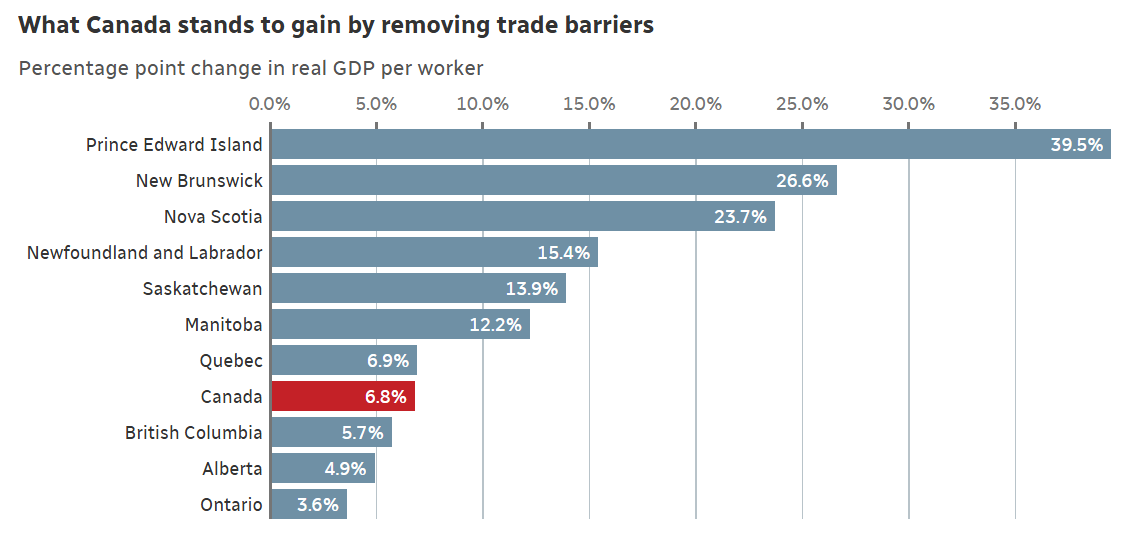
Source: International Monetary Fund (via CBC News)
The IMF singles out services as the main lever.
Removing barriers in finance, transport, and telecommunications would generate much of the GDP gain because services carry growing weight in the economy and act as inputs into nearly all other activities, the Financial Post reported.
CBC added that services account for the vast majority of internal trade costs and would deliver about four-fifths of the potential GDP gains in the IMF’s analysis.
This debate sits squarely in Canada’s broader productivity problem.
Nicolas Vincent, external deputy governor at the Bank of Canada, warned in a November speech that “years of weak business investment mean productivity in Canada is lower than it could be,” depressing wages, household spending and demand, the Financial Post reported.
He urged greater competition in sectors including telecommunications, financial services and transportation.
CBC reported that the IMF views current internal frictions as unusually severe by international standards, noting that more than 40 percent implicit barriers in some service sectors “would be prohibitive in most international trade agreements.”
For comparison, the Bank of Canada estimates that the US average tariff rate on Canada was 5.9 percent in November 2025.
Some progress has focused on goods.
The Financial Post reported that Ottawa passed Bill C‑5, giving federal recognition to goods, services and workers that meet requirements in one province, though provinces – which control licensing standards and procurement and services rules – have not fully matched that approach.
Bloomberg reported that Canada and its 13 provinces and territories signed the Canadian Mutual Recognition Agreement covering all goods except food, scheduled to take effect in December, and that most provinces and territories also agreed to allow direct cross-border alcohol sales to consumers by May 2026.
Canada continues to estimate a potential gain of about $200bn, or roughly six percent of GDP in the second quarter, from its wider effort to dismantle internal barriers, though a 2019 paper cited by Bloomberg put the maximum boost at about four percent.
Bloomberg also reported that Ontario became the first province in April to withdraw all of its exceptions under the country‑wide free trade agreement.
The Canadian Federation of Independent Business called the mutual recognition deal “a major step forward” and urged governments to extend it to services, food and alcohol.
Despite these steps, CBC reported that services remain largely outside national arrangements even though they drive most of the costs and potential gains.
A 2023 Statistics Canada survey cited by the Financial Post found that most Canadian businesses do not trade across provinces, often citing “lack of interest,” while a smaller share avoid interprovincial trade because of barriers and those that do trade report issues such as distance, transport costs and delays.
CBC stressed that further change rests mainly with provincial governments.
Alicia Planincic, director of policy and economics at the Business Council of Alberta, told CBC that “Canada isn’t really one economy. It’s really 10 economies,” and that “many, many thousands of rules and regulations” that differ by province make alignment complex and politically demanding.
Against a backdrop of weak productivity and slower global growth, Díez and Yang argue that “the case for integrating Canada’s internal market has likely never been stronger,” according to the Financial Post.
They estimate that removing interprovincial barriers could raise Canada’s output by about seven percent, or roughly $210bn, and say Canada has little choice but to keep pushing on this front.


