With USMCA uncertainty and housing stress building, Dustin Reid argues markets are underestimating how far the BoC may need to cut
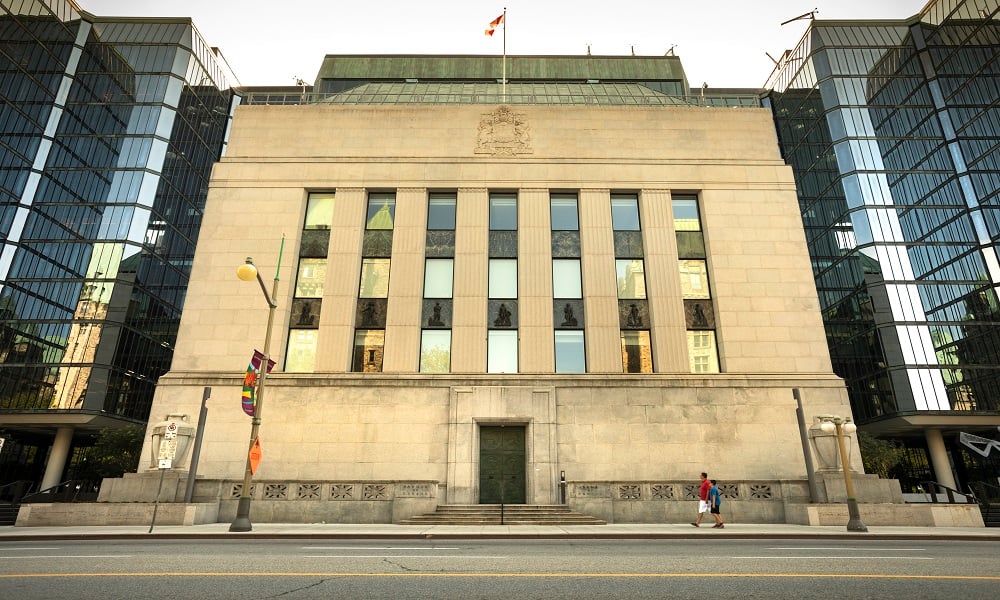
The Bank of Canada's decision to hold rates steady Wednesday came as no surprise to markets and institutional investors alike.
But what caught attention was the underlying tension between trade uncertainty and a softening domestic economy, a balancing act that Dustin Reid, VP and chief fixed income strategist at Mackenzie Investments, believes will tip toward rate cuts sooner than most expect.
“The bank seems to be a little bit more comfortable with the idea of potentially easing rates. Things don't look great on the USMCA front and appeared to be not as constructive on the domestic labour market situation, despite the relatively strong prints we had to finish last year during the fourth quarter,” said Reid.
“When you combine the inflation outlook, which continues to be relatively soft, and they're comfortable with the labour market read by the bank, and increasing risks around USMCA, the bank appears to be moving closer to my view that the bank will cut rates at some point in the first half of 2026, which remains not priced by the market,” he added.
Reid believes the Bank of Canada has made its priorities clear underscoring if economic demand weakens materially, it will cut rates, even with inflation running slightly above target. The bank's view, as Reid interprets it, is that a significant drop in aggregate demand would eventually pull inflation lower, though not immediately.
On current inflation readings, Reid sees little cause for concern at the central bank, particularly as the 2.4 per cent headline print doesn't trouble policymakers because their focus remains on core measures, which have been trending lower over the past six to nine months.
Core inflation, in the bank's framework, leads headline with a lag, giving them confidence the broader number will follow, he said. But the labour market picture is murkier, as unemployment has swung from above 7 per cent down to 6.5 per cent and back up to 6.8 per cent.
"The strength in the labor force survey data is not necessarily accurate in terms of where the current state of play of the labor market is," said Reid, pointing to the Survey of Employment, Payrolls and Hours (SEPH) data - Canada's establishment survey equivalent - which he believes paints a weaker picture. In his view, neither current inflation nor labor market readings would prevent the bank from cutting if conditions warranted it.
Additionally, Reid firmly believes that Canadian short-term rates are mispriced, and he is positioning portfolios to exploit that gap. He argues that, while the market is still assigning a small chance to additional hikes and only minimal cuts by mid‑year, his own base case is for a materially larger easing move, with no hikes at all.
According to Reid, this implies that yields on two‑year Government of Canada bonds are too high and should fall significantly as the Bank of Canada shifts to cutting. That outlook underpins a long bias at the front end of the Canadian curve across strategies that can bear the risk, especially in the firm’s short‑term Canadian fund.
He sees two very different paths for the Bank of Canada from here, depending on how demand and trade risks evolve.
On the upside, he concedes that if he has misread the economy, noting if aggregate demand and household spending accelerate, the unemployment rate improves, and corporate sentiment turns decisively more positive, the bank would more likely shift toward rate hikes.
With the overnight rate sitting at the lower bound of its neutral range, stronger demand and firmer inflation would justify tightening.
On the downside, he thinks markets are underestimating how far the bank may need to cut. While pricing only a token amount of easing by June, he expects at least a quarter-point, and potentially a half-point, of cuts over that horizon. He argues that risks tied to USMCA renewal, weakening domestic demand, and mounting housing vulnerabilities are not fully reflected in current market assumptions, creating a meaningful gap between his outlook and consensus.
For something more extreme, around a full percentage point of easing by mid‑year, he believes conditions would have to deteriorate sharply. That would likely require a serious breakdown in USMCA, with most cross‑border trade suddenly facing tariffs, delivering a heavy blow to aggregate demand and forcing the Bank of Canada deep into accommodative territory.
On the currency side, he is far less comfortable with a straightforward short‑Canada, long‑US dollar stance. The usual expression of a Canada-US policy divergence through FX, he warned, risks missing a more complicated global picture.
If large asset owners and official institutions step up hedging of US dollar assets without dumping the underlying securities, that could structurally pressure the greenback even as the Canadian dollar weakens. He added that he is worried recent rhetoric could be the catalyst.
“I am concerned that, particularly over the news flow of the last week or so, and even the last 24 hours, around Trump’s comments around the dollar, that we could see a ‘Liberation Day 2.0’, with respect to potential additional hedging of US dollars by global asset managers, which would be quite negative structurally for the US dollar,” he said.
Still, the USMCA review is a major source of uncertainty, and that alone makes it hard to take large, directional positions right now. His base case is that a deal ultimately gets done, but adjustments could weigh on confidence and growth.
That hesitation is already visible in corporate behaviour, he suggested, as senior executives delay discretionary capex, which helps keep Canadian growth subdued and, in his view, raises the odds of Bank of Canada cuts relative to what markets are pricing.
“A lot of the second half of the year, with respect to Canadian monetary policy, I think, will hinge on whatever that deal looks like, and the impact that the bank and people that talk to the bank believe it will impact the economy going forward,” noted Reid.