
CIBC Capital Market’s Avery Shenfeld argues North America’s outlook is less about doom and more about positioning through uncertainty
Each month at BPM, we offer a slate of articles and content pieces that go deep on a particular topic. This month, we're exploring fixed income as an asset class and the critical components that make up institutional portfolios.
The global economy is stuck in a rut, with growth hovering around 3 per cent, while geopolitical events continue to unfold, causing increased uncertainty for investors’ portfolios.
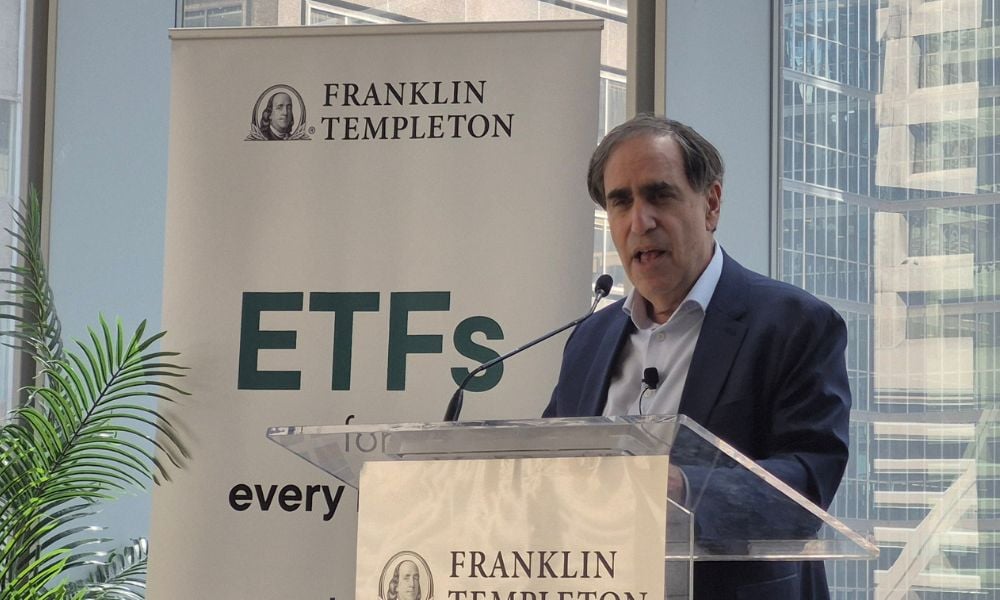
But for institutional investors rattled by the latest headlines from the Trump administration, the message a recent Franklin Templeton outlook event is to ensure investors take a breath, tune out the noise, and look for what's being mispriced.
"We're in a challenging world. It seems like with Donald Trump in the White House, virtually every week I come into the office and wonder whether everything I've published before now needs to be changed,” said Avery Shenfeld, chief economist at CIBC Capital Markets. “This week was no different where developments obviously have shaken the world up a bit... but pay no attention to that man behind the curtain," he added, citing The Wizard of Oz. "Donald Trump is going to say all sorts of things," but markets are learning that most of it never materializes, he added.
To that end, Shenfeld argued that the clearest signal on how the market is reading the conflict comes not from bonds or equities but from oil futures. While spot prices spiked, the end-of-year contract told a calmer story - one in which the disruption fades and supplies normalize before December.
After all, Trump's past military actions, from the bombing of Iran's nuclear facilities last June, to the one-day incursion into Venezuela, suggests a leader with little patience for drawn-out engagements.
Shenfeld believes a conflict lasting roughly a month is the most probable outcome and that kind of timeline is not enough to trigger a wave of new oil sands investment or force central banks off course. Inflation may tick up by a few decimal places in the near term, but policymakers will look through it. The real drag on markets, he said, is not the conflict itself but the fog around it.
“What you don't know worries investors. Uncertainty is the enemy of investors to some extent so we're certainly seeing a heightened level of uncertainty,” Shenfeld noted.
If oil falls back into the mid-$60 range once the war ends, Shenfeld suggests that would say less about geopolitics than about the broader economy, noting it would suggest global demand is still too soft to keep prices elevated on its own, reinforcing the view that the world economy remains sluggish rather than strong.
Shenfeld shifts away from valuation calls and toward growth outlooks, focusing on places where markets may be underestimating the chance of an upside surprise. In that framework, Mexico stands out.
He acknowledged that the country faces well-known problems, including cartel violence, weaker remittance flows, and trade uncertainty. But those issues are already widely understood and likely reflected in market expectations.
That’s why Dina Ting, senior vice president and head of global index portfolio management at Franklin Templeton, emphasized a forceful case for targeted country-level exposure rather than broad regional baskets, noting country returns are diverging, not converging.
"In 2025, the delta between the bottom performing country to the top performing country was 100 per cent," versus a more typical 50 to 60 per cent, said Ting. In that environment, a broad “international” allocation can blur meaningful differences, because country returns are being driven by local sector mix, domestic policy, and global forces that hit each market differently, she said.
She argued investors shouldn’t obsess over perfectly timing these swings so much as accept that leadership rotates. Notably, South Korea can surge one year while Mexico flips from top to bottom in another. Even the US, often treated as the default safe market, rarely finishes as the single best-performing country over long periods. With correlations between the US and other markets declining, diversification is starting to work harder, not less, said Ting.
She also flagged that monetary policy is no longer synchronized, highlighting Latin America is easing while Japan is an exception on the hiking path, while high absolute rates in places like Brazil and Mexico raise the cost of capital and shape business outcomes.
“It is really important to think about targeted country tilts beyond just broad market exposure," she said.
Yet what matters more, in Shenfeld’s view, is whether the economy can do better than that subdued baseline. He sees a few reasons it might, noting growth appears to be improving after a weak 2025, inflation expectations remain contained, and lower interest rates are starting to support activity, also underscoring there is scope for further easing that markets may not yet fully anticipate.
While the US economy is sending mixed signals, Shenfeld reads the underlying picture as healthier than it looks, noting GDP growth has been solid. The weak fourth quarter was largely a government shutdown artifact, while unemployment sits at 4.3 per cent, close to full employment.
And while hiring has stalled in cyclical industries, that partly reflects a shrinking labor force rather than collapsing demand, Shenfeld suggests. The shift to online retail and the capital-intensive nature of AI output also mean the economy is generating more GDP with fewer workers.
Shenfeld expects a mild deceleration as AI capital spending growth slows, immigration restrictions thin the consumer base, and tariff uncertainty lingers. That should be enough for the Fed to deliver a couple of rate cuts, even though core inflation remains stuck near 3 per cent. Long-term rates, however, are unlikely to fall much further given the scale of US government borrowing.
When it comes to trade, Mexico is still under pressure on finished autos, but it is benefiting in other areas from exemptions tied to the Canada-US-Mexico agreement. If trade talks break the right way, Shenfeld believes that could add another lift. The broader point is that Mexico does not need to become a standout economy to outperform expectations. Rather, it only needs to turn out somewhat better than the market currently assumes, said Shenfeld.
Meanwhile, Canada's outlook drew a blunter assessment as growth of 1.3 per cent this year is "kind of eh," said Shenfeld, while the housing market remains weak despite rate cuts. He sees the Bank of Canada sitting pat but warned it should be ready to move if trade negotiations stumble.
The worst-case scenario - an immediate US withdrawal from the trade agreement with six months' notice and a wall of new tariffs - would amount to a recession in the country.
"That's really the disaster scenario that I'm still hopeful we can avoid," he said. “Yes, Donald Trump says a lot of nasty things about Canada, but his trade negotiators have prepared a fairly detailed laundry list of what they're seeking in these negotiations and none of the items on that list look like they're grounds for Canada walking away. We are, of course, trying to do what I would call Plan B, which is find alternatives to being so reliant on the US economy.”


