Best Companies to Work for in the Benefits, Pensions, and Institutional Investment Space | Top Employers
Jump to winners | Jump to methodology
Culture builders
Inflation, turnover costs, and rising employee expectations are redefining how the best companies to work for in the benefits, pensions, and institutional investment space retain their top people.
BPM’s Top Employers 2025 are a collection of exemplary firms meeting those challenges with an average employee satisfaction score of 81 percent, well above the 75 percent recognition threshold.
Top takeaways from this year’s winners scoring (1 = not important and 5 = very important):
1. Compensation and benefits
-
Overall compensation satisfaction is strong among leaders, with scores generally above 4 for most top organizations. Notably, Alberta Retired Teachers' Association (ARTA), WISE Trust, and The Benefits Trust lead here.
-
Healthcare and retirement benefits are standout strengths, especially for WISE Trust (4.69, 4.92) and ARTA (4.62, 4). This highlights the importance of robust benefits packages in driving satisfaction.
-
Bonus/incentive programs and loyalty leave/sabbatical structures show more variability, with some organizations lagging, suggesting these are areas for potential improvement even among top performers.
2. Career development and advancement
-
High scores in fair performance evaluation and professional development (e.g., ARTA: 4.49, 4.68; WISE Trust: 4.46, 4.77) indicate that transparent evaluation processes and investment in employee growth are key differentiators.
-
Career advancement opportunities ratings reinforce the value of clear pathways for progression.
3. Workplace culture and environment
-
Workplace culture and work-life balance are consistently strong across top organizations, with scores often above 4. The Benefits Trust and WISE Trust excel, indicating that a positive, flexible culture is a hallmark of high satisfaction.
-
Flexible work options are particularly valued, with WISE Trust achieving a perfect 5, underlining the competitive advantage of flexible arrangements.
4. Wellness, inclusion, and recognition
-
Health and wellness programs and family-friendly benefits are well-rated, though there is some variability. Leaders set the bar high, suggesting that comprehensive wellness and family support are increasingly expected.
-
Diversity and inclusion and employee recognition are strong differentiators for top organizations, with scores above 4 for most leaders.
5. Engagement, communication, and security
-
Inspiration, feeling valued, and open communication are highly rated, especially at WISE Trust and ARTA, highlighting the importance of transparent leadership and employee appreciation.
-
Job security and safe work environments are consistently high, with most top organizations scoring above 4.4, reflecting a foundational expectation among employees.
Robert Half permanent placement services director, Cal Jungwirth, reinforced these findings.
“Candidates and employees want organizations that treat people with respect and offer opportunities that aren’t one-size-fits-all,” he says. “Everyone is looking for something slightly different, and companies that can cater to individuals build a stronger reputation and retain their staff the longest.”
Celebrating leadership in the benefits, pensions, and institutional investment space
The ability to recruit and retain talent hinges on how well organizations align their offerings with employee priorities. This is a market where competition is constant and workplace expectations keep evolving.
BPM’s third annual Top Employers report identifies the organizations nationwide that are meeting those challenges. This year’s winners deliver across the full spectrum of employee experience, including:
-
flexibility and holistic benefits
-
career growth and transparent evaluation processes
-
inclusive cultures and open communication
-
job security and safe work environments
To be considered, employers first described their workplace programs and policies. Then, employees from these organizations took an anonymous survey evaluating them over 21 criteria.
Measuring market challenges against
Top Employers’ success
Retention and turnover pressures intensify
The Canadian labour market continues to contend with attrition that drains budgets and erodes momentum.
A June 2025 Express Employment Professionals - Harris Poll found that 28 percent of hiring managers expect turnover to rise this year, with the average annual cost pegged at $29,234 per business. For 17 percent of employers, the number exceeds $100,000, most often in large organizations with 500 or more staff.
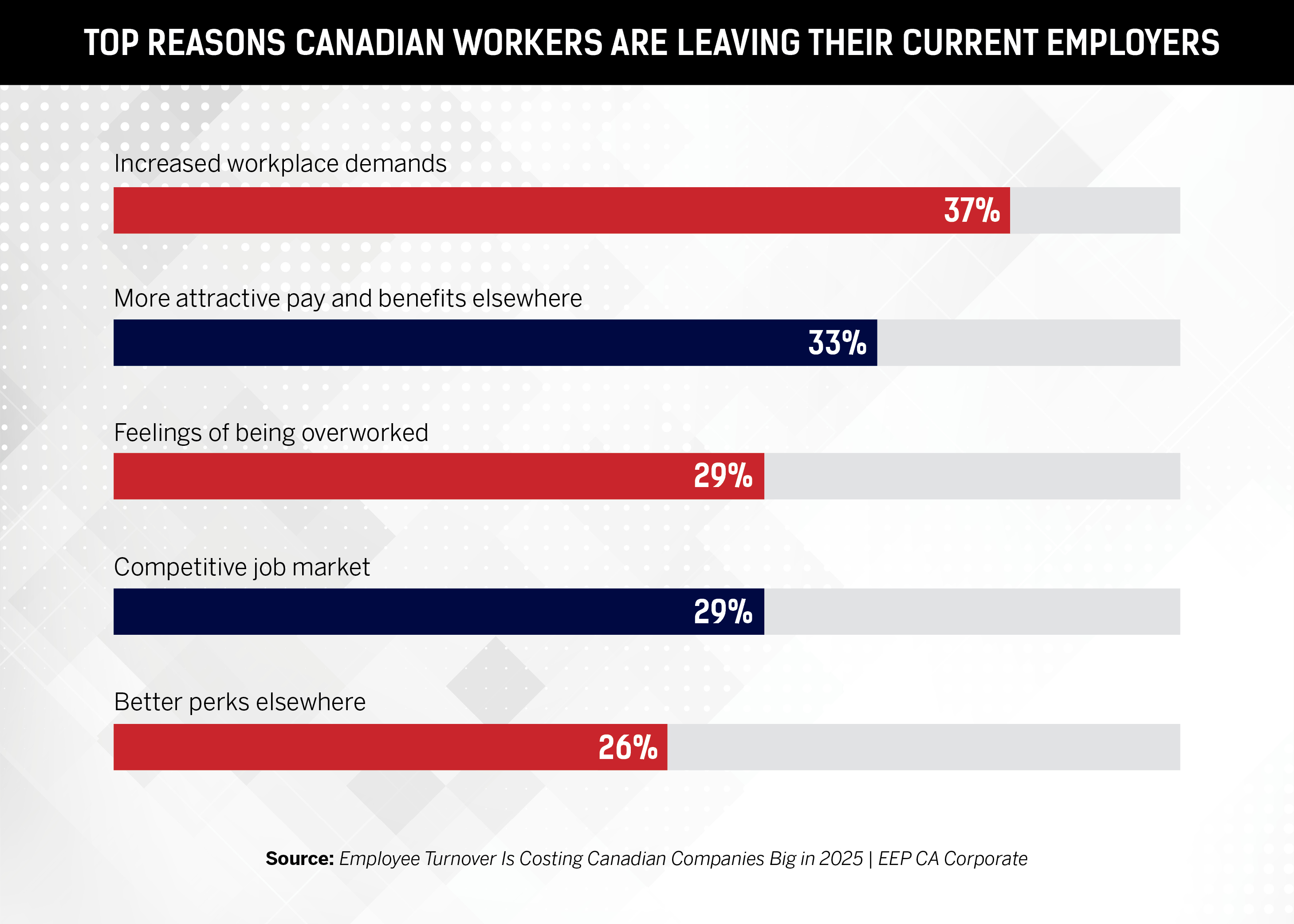
The drivers are familiar but pressing.
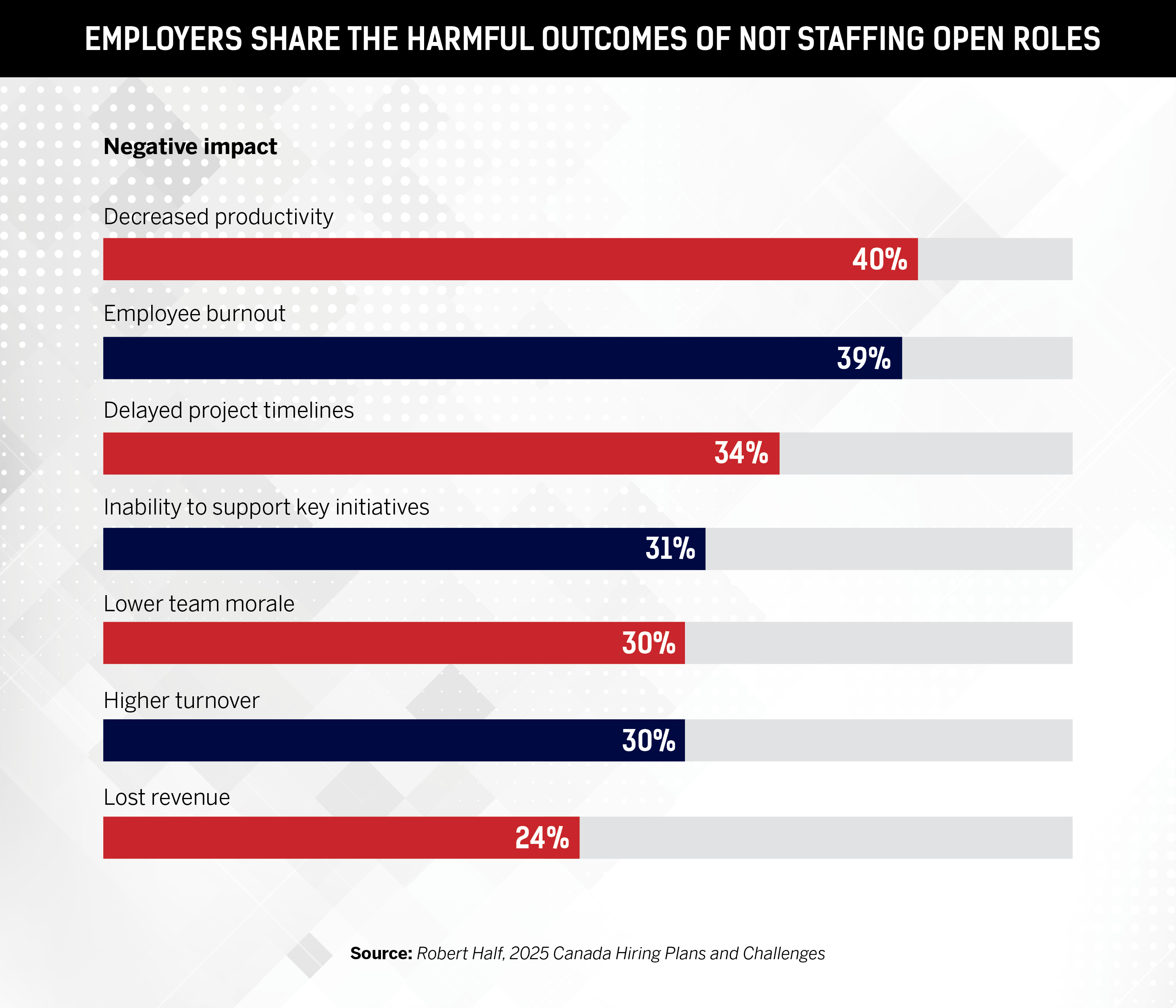
Despite these challenges, hiring remains a top priority, with 83 percent of hiring managers saying they plan to hire in 2025, in line with last year. Notably, 38 percent of those planning to hire say they need to replace employees lost to turnover.
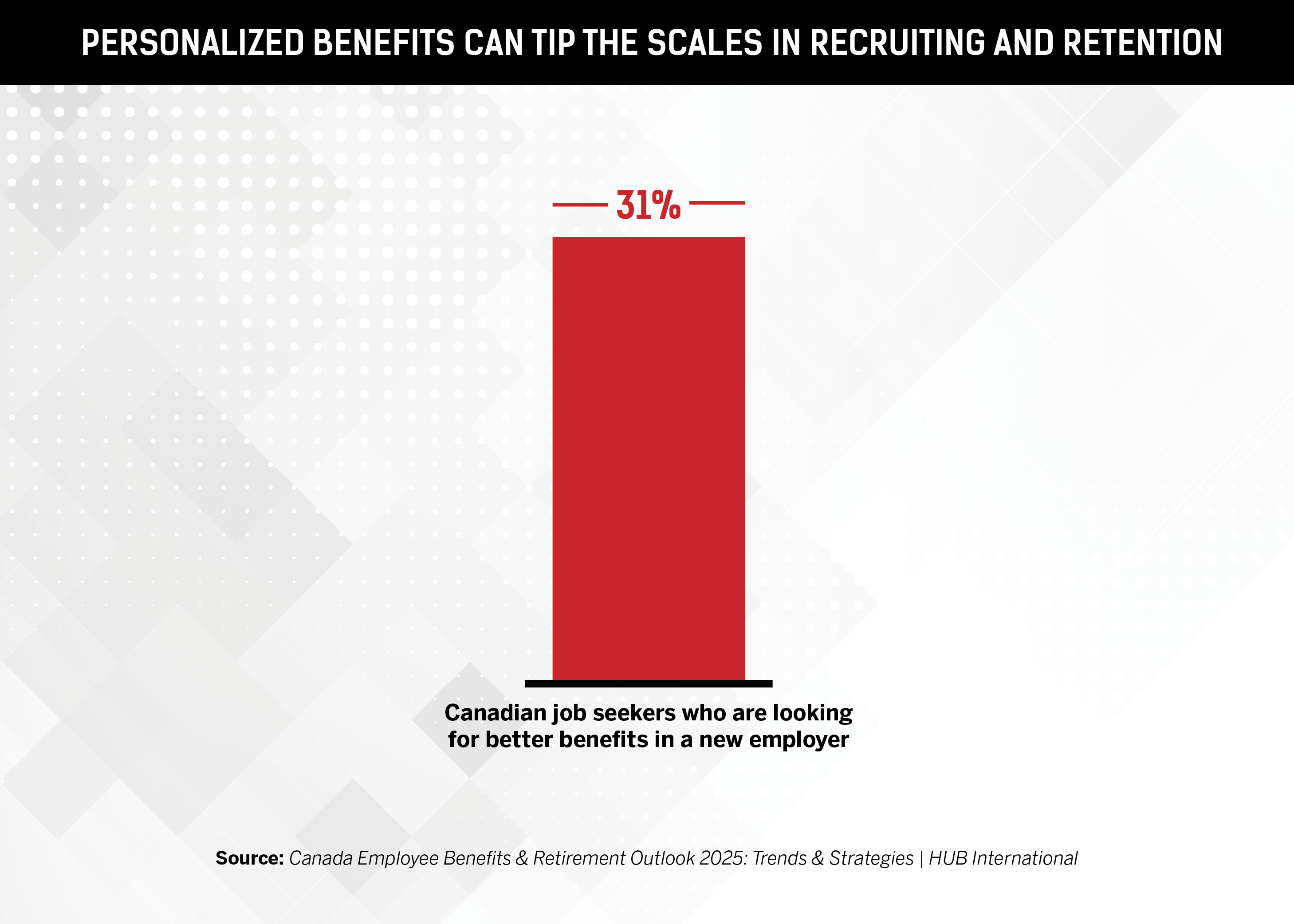
Robert Half’s July 2025 research shows 26 percent of professionals plan to change jobs in the second half of the year, while 40 percent are open to new offers. Better benefits now edge out higher pay as the leading motivator.
BPM’s data shows that the Top Employers are bucking the wider market’s volatility. With an overall satisfaction average of 81 percent and top performers scoring 4.14 on “feeling valued,” these organizations are building environments where employees are more inclined to stay.
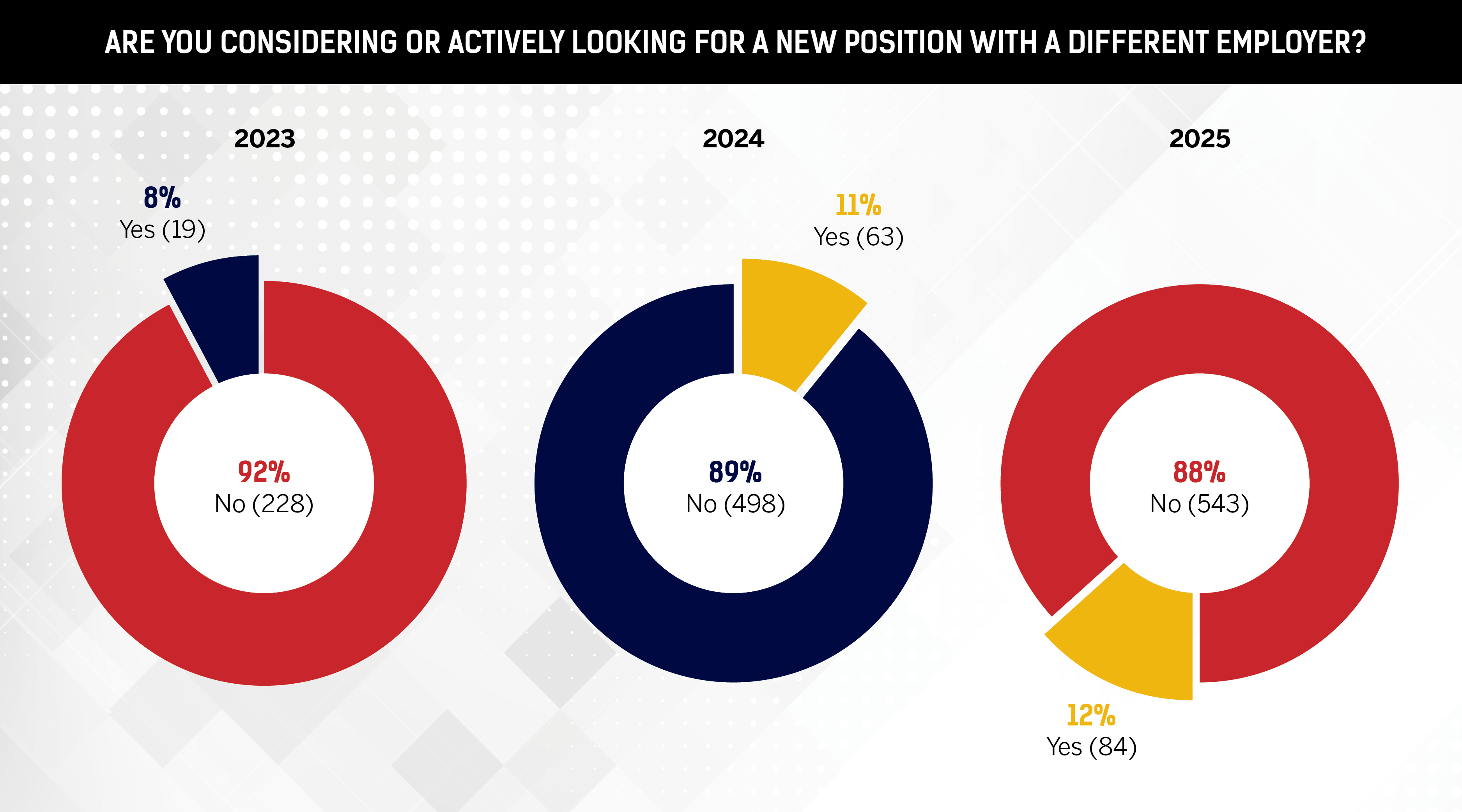
Willingness to leave for a better work arrangement fit sits at 43 percent, but 79 percent of employees – well ahead of the industry norm – are not actively looking for a new role.
Even so, the share of employees considering a move has climbed from 7.7 percent in 2023 to 12 percent in 2025, underscoring the need for continued focus on retention drivers such as flexible work, recognition, and alignment between role and personal priorities.
Benefit costs drive strategic response
The rising cost of medical benefits is reshaping how companies plan and deliver coverage. Two-thirds of Canadian employers cite this as a major concern for 2025, according to HUB International’s Outlook Executive Survey.
Canada now ranks third highest among OECD countries for pharmaceutical prices, with biologics and specialty drugs pushing costs higher. Twenty-two percent of Canadians say they skip doses or fail to fill prescriptions because of cost, and 10 percent have landed in the emergency room as a result.
Analytics and personalization are emerging as key strategies. HUB’s survey shows 74 percent of employers view analytics as highly important to benefit design. Predictive analytics, in particular, allow HR teams to anticipate needs rather than react to problems.
BPM’s Top Employers are already aligning benefits with employee priorities. Medical coverage satisfaction averaged 4.22 across winners, reinforcing the link between meeting top-ranked needs and retaining talent.
While personalization of benefits can be a tight rope for organizations to walk, Jungwirth says, offering even two or three choices goes a long way versus just one standard package.
He adds that leading employers aren’t guessing at what people want, they’re asking and responding.
“The best employers listen to their teams and then, to the best of their ability, cater their packages,” he explains. “Flexibility comes up again and again, whether it’s hybrid arrangements or other forms of work-life balance, and employers that keep offering it are standing out. On the benefits side, additional mental health support, extended health coverage, and expanded parental leave are going a long way in attracting and keeping talent.”
Similarly, the Conference Board of Canada’s human capital team stresses that customizability and/or personalization of offerings is vital for top employers.
“Employees have unique needs that may be currently underserved by traditional benefit offerings,” says director Alana Painter. “Moving away from a one-size-fits-all approach allows employers to better meet employee needs.”
Associate director Liz Marcil adds, “Also, affordability is a concern we are hearing from organizations about rapidly increasing costs of benefits.”
The Board’s research and discussions with organizations indicate a growing interest in customizing benefits to better meet employee needs while controlling costs. It also suggests that, to achieve this, organizations should assess the gap between current offerings and employee preferences, and collaborate with providers to identify cost-effective solutions that close those gaps.
Pension plans expand, but needs vary
The number of Canadians in registered pension plans grew 4.2 percent in 2023 to more than 7.2 million, according to Statistics Canada. Defined benefit plans remain the majority, covering 68.1 percent of members. Women now hold 56 percent of DB memberships, reflecting steady participation gains in Ontario, Quebec, and British Columbia. Retirement benefits, along with health, are among the top five total rewards for employees, according to Conference Board of Canada research.
Top Employers in BPM’s survey often outperform on retirement readiness measures. Those scoring 4.4 or higher in retirement planning satisfaction tend to see strong engagement, suggesting a strong alignment between benefit design and lifecycle priorities than is typical in the wider market.

Employee expectations redefine the offer
The most compelling finding in Randstad’s March 2025 Employer Brand Research is the growing expectation gap around salary and benefits, coupled with the rising importance of work-life balance and career growth.
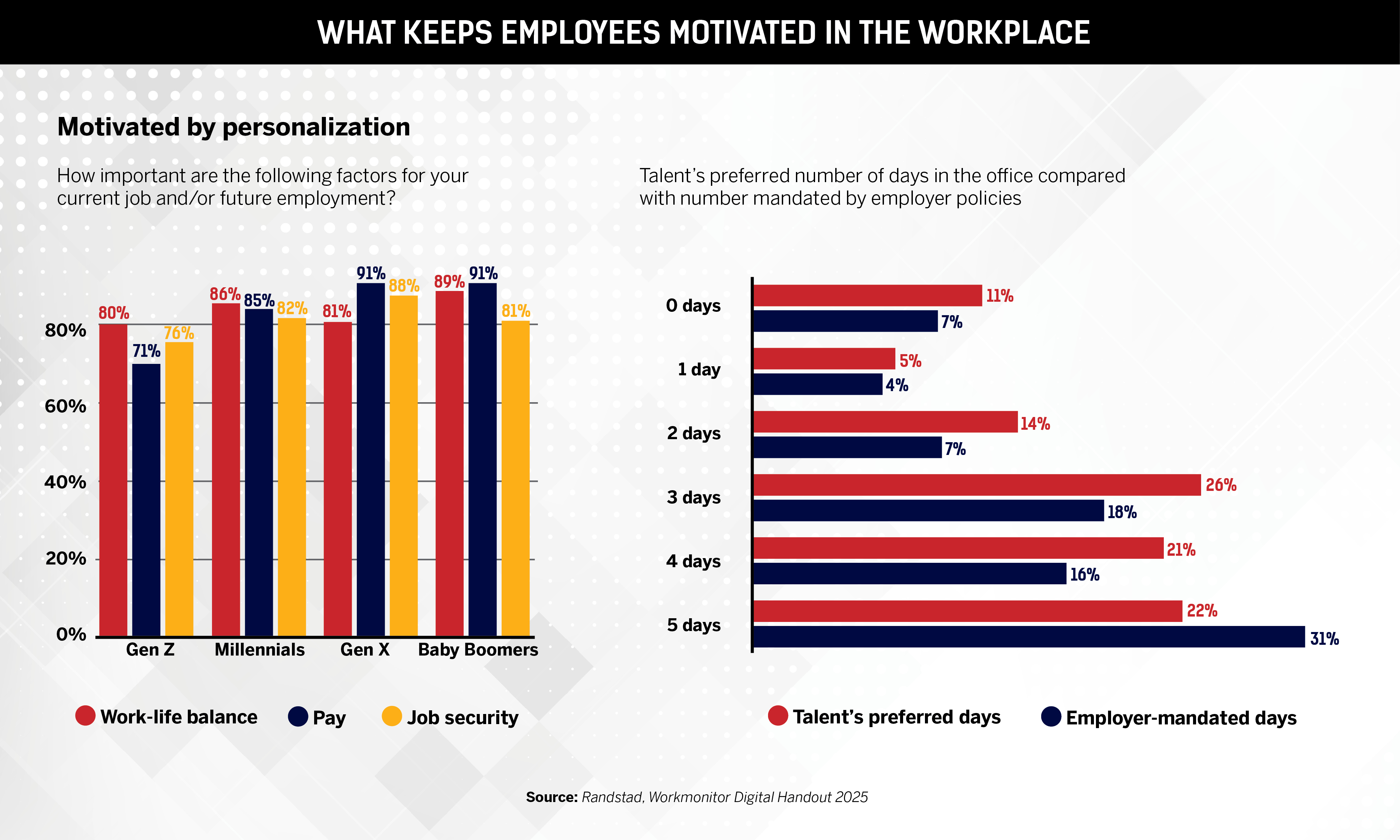
What’s more, for the first time in its 22-year history, Randstad’s Workmonitor report found that work-life balance has overtaken pay as the top motivator for Canadian employees. A sense of belonging is also critical, with 86 percent saying it improves performance and well-being.
The 2025 Hays Salary Guide found that nearly 85 percent of organizations reported increasing difficulty attracting new talent.
Other employee findings include:
-
48 percent feel that their current roles offer no opportunities for career progression.
-
43 percent want to leave their jobs because of a lack of career progression.
-
39 percent believe that not everyone gets fair access to growth opportunities within their organization.
-
37 percent feel that pay processes are neither transparent nor fair.
-
55 percent report their organization takes none of the three main steps for pay transparency.
-
44 percent did not receive a salary increase in 2024.
BPM’s data shows that the Top Employers are meeting these rising expectations head-on. Professional development scores average 4.21 and career advancement opportunities 3.92, signalling stronger internal mobility than the broader market, where nearly half of employees see no path forward.
Hybrid work is standard among the winners, aligning with the national preference for flexible arrangements and helping counter the 43 percent who would otherwise leave over a poor work fit.
These results suggest that leading employers are avoiding the pitfalls flagged by Randstad and Hays, and they are actively building value propositions that keep their people engaged and off the job market.
Wellness and retirement readiness in focus
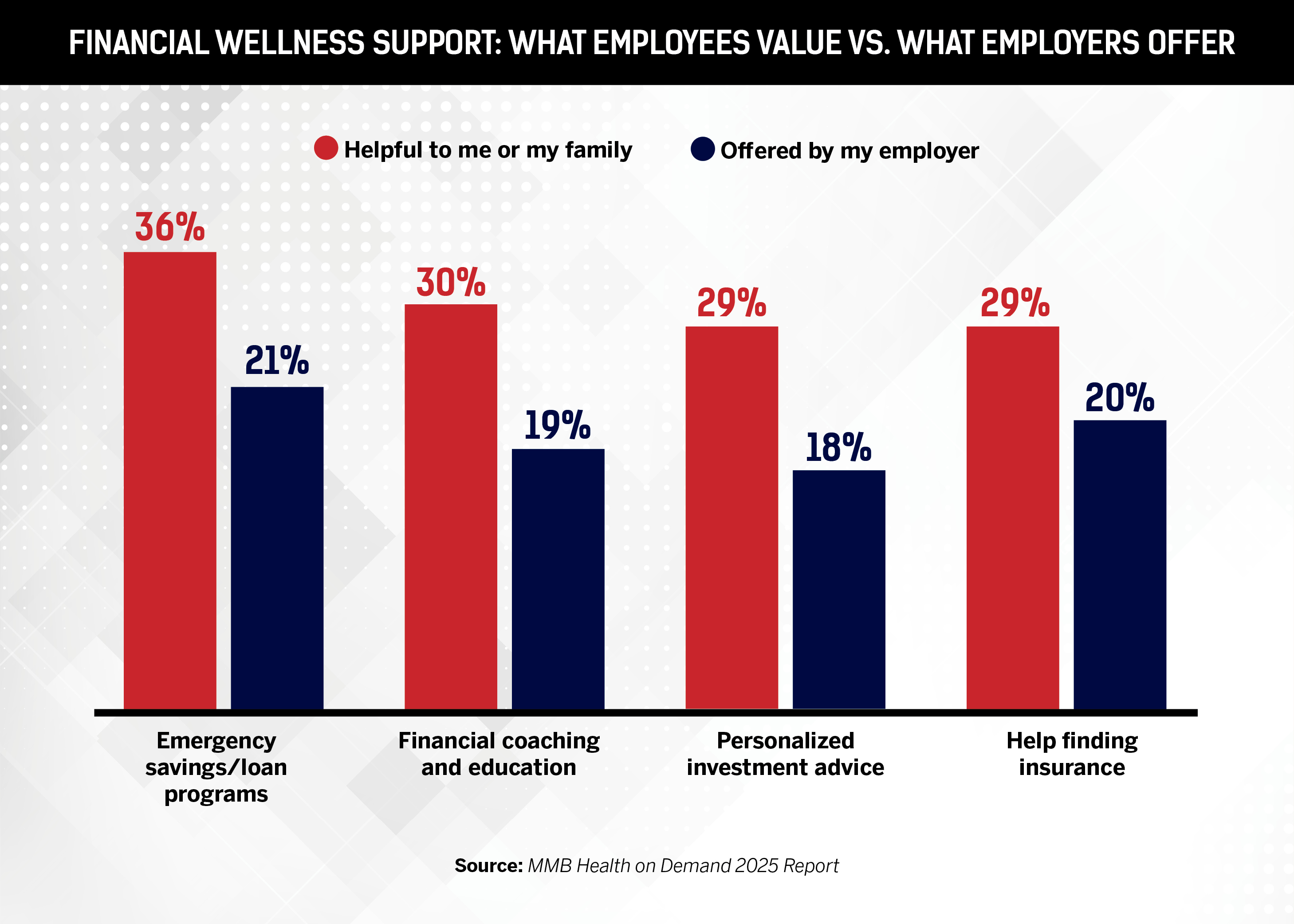
Well-being gaps remain a significant test for employers. The Mercer Marsh Benefits May 2025 report found that only 59 percent of Canadian employees feel their benefits meet their needs, with mental health screenings still limited despite nearly half expressing concern about mental or emotional decline.
Personalization is a differentiator: 78 percent of employees with customizable benefits believe their employer cares about their health, compared with just 29 percent without that option.
More benefits also translate into higher engagement, with 76 percent of employees receiving 10 or more employer-sponsored benefits saying they are thriving in their role.
Retirement readiness is another area where targeted benefits have a measurable impact. Flexible savings options can bring forward the average retirement age from 69 to 67, especially for lower-income employees, while 79 percent of workers say they would welcome employer help in planning for health needs in retirement.
Financial stress remains widespread, with nearly half of employees worried about covering monthly expenses, affording retirement, or buying a home.
BPM’s Top Employers are closing many of these gaps. Health and wellness satisfaction averages 4.1 among winners, and many have aligned benefits with employee priorities, from mental health and family-friendly policies to long-term financial security. Jungwirth notes that, interestingly, Robert Half research shows that workers across the generational divide are looking for the same things.
“We’re seeing demand for strong vacation packages, paid time off, extended and flexible health coverage, and retirement savings plans. Younger employees are starting to understand the value of saving for the future, especially as the cost of living has gone up. And whether it’s benefits or work arrangements, flexibility is a word that keeps coming up; it’s a big part of how you build respect, trust, and loyalty.”
These organizations are delivering the kind of personalized, comprehensive packages Mercer Canada identifies as a competitive advantage. This approach is helping them retain talent in a market where benefit gaps still drive employees to look elsewhere.
How BPM’s Top Employers stack up against
employee expectations
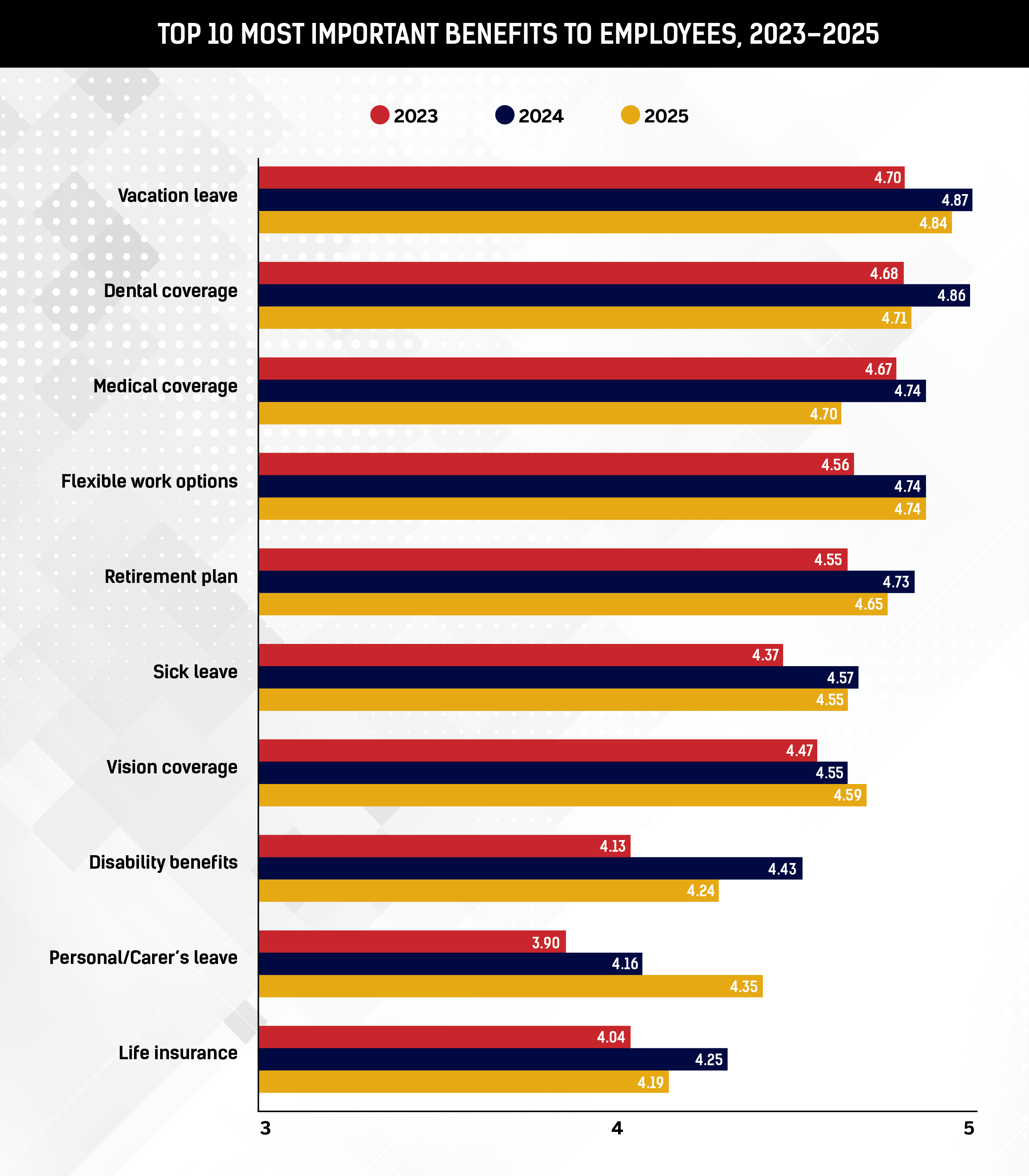
BPM’s 2023–2025 data points to a familiar pattern at the top, but the small trends reveal where employee sentiment is evolving:
-
Vacation leave has increased every year, climbing from 4.70 in 2023 to 4.84 in 2025.
-
Flexible work options made their biggest jump between 2023 and 2024, then stayed in the upper tier.
-
Personal/carer’s leave saw the steepest single-year rise in 2025, reflecting a more pronounced focus on balancing work with personal demands.
-
Other benefits in the top 10 have barely moved, posting consistently high scores that show how much employees still value the basics.
These patterns set the stage for a closer look at where the best companies to work for in the benefits, pensions, and institutional investment space are meeting expectations and where gaps could be opening.
Core benefits are a differentiator when satisfaction matches importance
-
Vacation leave, rated most important in each year, posts strong satisfaction scores across winners, with leaders such as The Benefits Trust and Fidelity Canada setting the pace in 2025.
-
Dental and medical coverage consistently ranked highest for importance and satisfaction, with standouts including ARTA, WISE Trust, and OTIP leading the way.
Flexible work has moved from a preference to a core expectation
-
Importance: 4.56 in 2023, climbing to 4.74 in 2025, placing it firmly among the top five priorities.
-
Satisfaction: Many winners exceed the average 4.28, with WISE Trust at 5 in 2025, followed closely by The Benefits Trust, CAAT Pension Plan, and Fidelity Canada.
-
Hybrid remains the most common arrangement in 2025 at 62 percent, with only six percent of employees fully office-based. In terms of preferences, 46 percent favour hybrid, 28 percent want to work fully remote, and 21 percent prefer to decide for themselves.
Engagement opportunity: listening to staff
-
In 2025, only 43 percent of employees say their employer canvassed them for views on benefits or conditions, down from 52 percent in 2024 and 68 percent in 2023.
-
Companies closing this loop are more likely to score above 4.4 in “feeling valued” and “open communication”.
Retention risk tied to flexibility and growth
-
While 79 percent of 2025 respondents are not actively looking to leave, 43 percent say they would switch jobs if a role offered better work-arrangement fit.
-
Importance ratings for professional development have stayed above 4 for three years, yet satisfaction lags in some organizations below 4.
Multigenerational needs continue to drive benefit strategy
-
The workforce spans from 18 to 60+, with the largest cohorts aged 30–39 (33 percent) and 40–49 (27 percent).
-
Leaders in family-friendly benefits (4+) and retirement planning (4.4+) score well across the workforce.
Top Employer 2025 spotlights
Alberta Retired Teachers’ Association
-
Lead stats: 86 percent in overall employee satisfaction | 4.68 for dedication to professional development
When CEO Daniel Mulloy joined the Alberta Retired Teachers’ Association (ARTA) as its first non-retired teacher executive director over 15 years ago, the organization faced a crossroads.


Daniel MulloyAlberta Retired Teachers’ Association
“They were on the precipice of making a decision whether they were going to stay small or grow big,” he recalls. “The one thing I wanted to do as we built our organization was make it a place I wanted to go to work – a place that had fun, that had humour, and that prioritized people over product. I think that’s really unique about us: we’re a family environment with a business mentality.”
For aspiring top employers that want to build a values-driven workplace, Mulloy offers this advice, “Start by being authentic. If you don’t hold true to your values, from the top down, you’re going to lose employees faster than you can imagine.”
And he adds, “I think we’re truly authentic in the work that we do and the people that we are. If you have a little humour and a lot of heart, you’ll make people excited to come to work every day, even on a Monday.”
From the outside, running benefits plans and operating a pharmacy might sound like a world of spreadsheets and prescriptions. Inside, the atmosphere is closer to a collegial staffroom.
In July 2025, an ice cream truck pulled into the parking lot. At Christmas, the office becomes a battleground for decorating contests where bragging rights are on the line. Between formal meetings, it might be a bad joke over lunch, coffee from a pot that’s never empty, or the occasional doughnut making the rounds.
“We take the work seriously, but we take time to stop, laugh, and have some fun,” Mulloy says. That approach, he adds, has kept morale high and staff connected to each other and to the mission.
In the years ahead, he wants to maintain consistency by being:
-
welcoming
-
light-hearted
-
attentive to employees' mental, physical, and emotional well-being
Staff development is central, and ARTA supports employees’ education and growth, expecting them to believe in the work as much as they believe in their colleagues. In a competitive labour market, the organization’s blend of benefits, flexibility, and genuine connection has kept engagement high, an outcome it set out to achieve from the beginning.
Fidelity Canada
-
Lead stats: 87 percent in overall employee satisfaction | 4.61 for safe work environment, the highest score in the survey
Fidelity Canada opened its doors nearly 40 years ago, on Oct. 19, 1987, Black Monday. Today, the Top Employer collectively manages over $466 billion in assets under management and administration, serving over two million retail customers, and a range of institutional clients such as private sector employers, pension funds, universities, and more.
Diana Godfrey, senior vice president of HR and corporate affairs, has a unique insight into the company’s growth, not only as head of people and workplace culture, but as an employee herself, having joined the company in 1995.

Diana GodfreyFidelity Investments Canada
She says, “Over my 30-year career, Fidelity Canada has been consistently investing in our people and the culture, and I think having both a client and an employee-centric approach to work has made a real difference.”
The company’s commitment to employees is multifaceted and holistic. A significant part of that is a constantly improving its benefits framework. From comprehensive health coverage to paid family care leave, Fidelity Canada’s competitive offerings support employees and their families’ well-being, which helps them be engaged and build long-term careers.
“When people feel supported and engaged, they perform exceptional work for each other and our clients,” adds Godfrey. “Improving the employee experience is a real focus for us every day, because it directly improves the client experience, which contributes to business growth over the long term.”
Culture is at the forefront of maintaining an award-winning standing, and as such, leaders are committed to and encourage:
-
open communication
-
collaborative problem-solving
-
a sense of shared ownership in results
“Our culture of listening differentiates us as a top financial services provider and top employer because we frequently act on feedback to improve our offerings and employee experience,” Godfrey says.
Its dedication to employee well-being is reflected in both initiatives and daily practices. Wellness programs include mental health resources, fitness subsidies, and ongoing educational sessions covering topics such as financial planning and healthy living.
Professional growth is treated as an investment. Fidelity Canada provides formal training, mentorship, and opportunities for internal career advancement. Success is celebrated by acknowledging team and individual milestones and wins, connecting through social events, and larger company-wide initiatives.
Fidelity Canada's strategy is anchored in three priorities:
-
delighting its clients
-
improving how the company operates
-
building a great place to work
Each priority ties back to the employee experience, with the understanding that engaged employees deliver stronger results, with numbers to back it up. Fidelity Canada's turnover sits well below industry standards, and employee engagement scores continue to improve year after year. Leaders cite flexibility, competitive benefits, and meaningful development opportunities as some of the reasons for this success.
“Employee engagement remains a focus, as engaged employees contribute positively to the performance of the firm as both an investment management company and employer,” says Godfrey.
From comprehensive benefits to a culture of respect and opportunity, Fidelity Canada has built a workplace that exceeds professional expectations while giving people compelling reasons to stay. That consistency, reinforced over time, has helped the company secure its place among the top employers in Canada’s asset management sector.
The Benefits Trust
-
Lead stats: 83 percent in overall employee satisfaction | 4.75 for safe work environment, the highest score in the survey
Employees describe The Benefits Trust as a workplace where approachable leaders are accessible, listen to concerns, and foster genuine two-way communication. Staff point to regular social events, daily gestures of appreciation, and a friendly, non-clique environment where everyone works as a team.
Flexible work arrangements, including hybrid schedules and time off for appointments, combine with generous benefits, PTO, and RRSP matching to create a healthy work-life balance.
Opportunities for learning, professional growth, and community giving further add to the appeal, while a family-friendly atmosphere makes people feel connected and valued.
“We train, empower, and equip our team to exceed our clients’ needs and expectations, and we have fun doing it,” says president Robert Crowder.
CAAT Pension Plan
-
Lead stats: 82 percent in overall employee satisfaction | 4.54 for retirement plan
Employees describe CAAT as a purpose-driven workplace where the mission of delivering defined benefit pension security to more Canadians gives their work lasting meaning.
A respectful culture is reinforced by approachable leaders who communicate openly, welcome feedback, and promote inclusion at every level.
As talent development director Robin Mahadeva notes, “Our inclusive and collaborative culture is at the heart of what makes this a place where people want to stay and grow.”

Robin MahadevaCAAT Pension Plan
CAAT celebrates differences, encourages innovation and learning, and consistently recognizes the contributions of every “CAATster”. Exceptional benefits, a market-leading pension, and generous hybrid and remote options support work-life balance, while wellness programs address mental, physical, and financial well-being.
“Our comprehensive total rewards program supports our employees’ well-being in all aspects of life – physical, mental, and financial – while flexible work arrangements, paid leave, and additional perks reflect our commitment to work-life balance.”
In addition, CAAT’s philosophy combines:
-
competitive compensation
-
performance recognition
-
clear career pathways
Professional development is encouraged through mentorship, leadership programs, tuition assistance, and a variety of skills-based learning opportunities.
WISE Trust
-
Lead stats: 90 percent in overall employee satisfaction | perfect 5.0 for flexible work options
Employees consistently highlight a workplace that invests deeply in their growth, values their input, and supports their well-being. Professional development is a clear priority, with significant resources devoted to skills-building, leadership programs, and opportunities to expand roles. The WISE Trust fosters engagement through team events, open forums for feedback, and inclusive decision-making, while maintaining a 100 percent remote environment that supports flexibility and work-life balance.
Benefits are described as exceptional, with generous health coverage, a defined benefit pension plan, and strong wellness initiatives addressing mental, physical, and financial health.
Respondents also offered praise for:
-
approachable, respectful leadership
-
collaborative culture
-
meaningful work aligned with the mission
Direct access to senior leaders, involvement in diverse projects, and recognition of contributions help maintain a sense of connection, even in a remote setting.
“Our people are at the heart of everything we do,” people and culture director Shannon Bury explains. “Delivering secure, sustainable pensions and meaningful education to our Plan members starts with our people, whose expertise, care, and collaborative spirit bring our mission to life.”

Shannon BuryWISE Trust
Centurion Asset Management
-
Lead stats: 80 percent in overall employee satisfaction | 4.43 for safe work environment
Centurion builds its culture with intention, measuring it weekly and anchoring it in belonging, recognition, and support.
“We’re not interested in creating a workplace where people clock in and out,” explains executive vice president of human capital Laura Salvatore. “We’re building a community where people feel they’re part of something bigger: where wins are shared, collaboration is natural, and the idea of ‘one team, one dream’ is a daily reality.”

Laura SalvatoreCenturion Asset Management
Employees highlight a respectful and transparent culture where senior leadership values contributions and fosters teamwork. Perks such as wellness programs, health initiatives, and everyday comforts, such as free snacks, contribute to a positive and balanced work environment. A focus on client service, manageable workloads, and ongoing growth initiatives reinforces both employee satisfaction and organizational success.
The Top Employer is selective about hiring, and if someone doesn’t align with its core values of respect, integrity, simplicity, and excellence, leaders don’t force a fit.
Learning and career development are embedded in the employee experience:
-
every new hire has a six-month mentorship
-
230 promotions in the past 7 years, 57 percent of whom were women
-
stretch assignments
-
job shadowing
-
Centurion Learning Academy
-
People Leaders’ Book Club
“Our people are our edge,” Salvatore adds. “With 85 percent of our roles being direct-sourced, we’re intentional about who we bring in, ensuring we create teams that are diverse, representative, and grounded in mutual respect. It’s not about hiring fast; it’s about hiring right.”
Defining the new standard for Top Employers
BPM’s 2025 results point to three defining traits that set this year’s Top Employers apart in the benefits, pensions, and institutional investment space:
-
Retention is now experience-driven: Leading employers integrate flexibility, recognition, and growth into everyday work, not just programs.
-
Benefits are strategic and personalized: Data-led design and tailored health and retirement plans are keeping top talent engaged.
-
Authentic leadership is a retention lever: Accessibility, values-driven decisions, and genuine listening carry as much weight as pay.
The Best Companies to Work for in the Benefits, Pensions,
and Institutional Investment Space | Top Employers

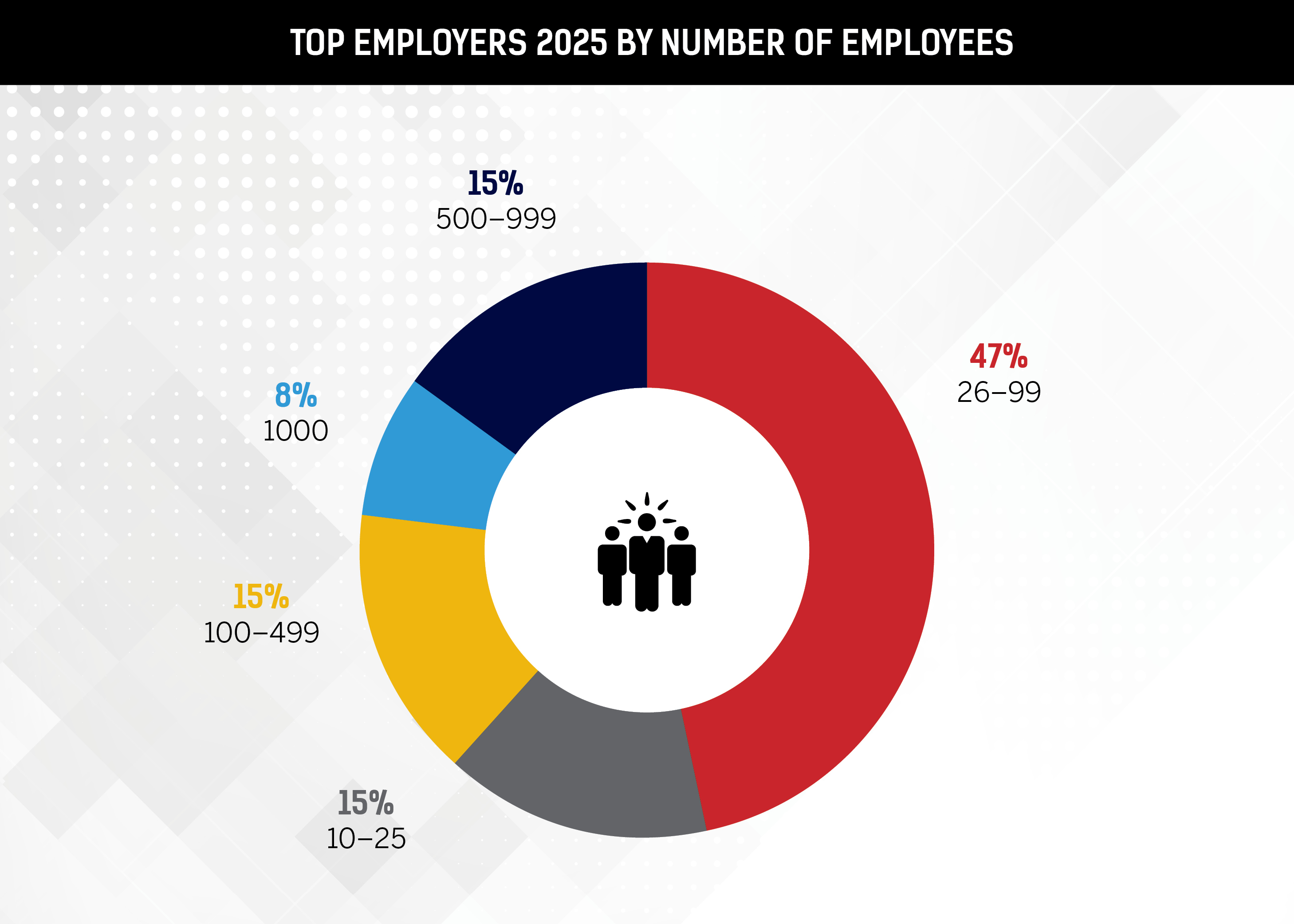
1,000+ employees
500–999 employees
100–499 employees
- Acclaim Ability Management
- Centurion Asset Management
26–99 employees
- Oliver Benefits Software
- Owen & Associates
Insights
its findings.
-
 Cal Jungwirth
Director, Permanent Placement Services
Robert Half -
 Alana Painter
Director, Human Capital Team
The Conference Board of Canada -
 Liz Marcil
Associate Director, Human Capital Team
The Conference Board of Canada
Methodology
To find and recognize the best employers in the benefits and pensions industry, Benefits and Pensions Monitor first invited organizations to participate by filling out an employer form, which asked companies to explain their various offerings and practices. Next, employees from nominated companies were asked to fill out an anonymous form evaluating their workplace on a number of metrics including benefits, compensation, culture, employee development, and commitment to diversity and inclusion.
To be considered, each organization had to reach a minimum number of employee responses based on its overall size. Organizations that achieved a 75 percent or greater average satisfaction rating from employees were named Top Employers for 2025.