
'We argue this system, facilitated by payroll deduction, creates a practical solution for strengthening financial resilience among Canadians,' says the Financial Wellness Lab
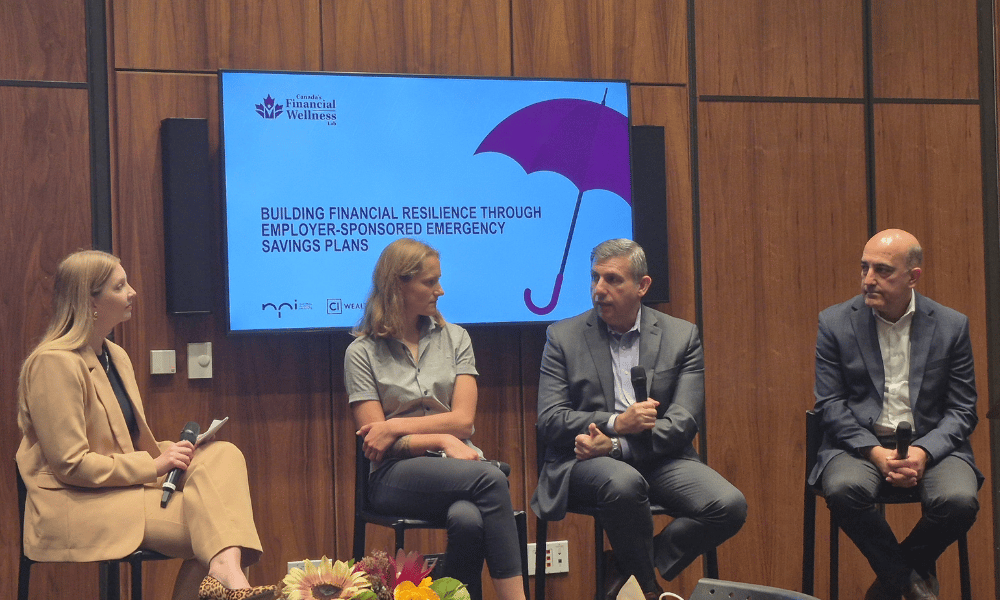
Financial wellness leaders are calling on employers and plan sponsors to consider implementing a dedicated “rainy day” fund to deal with the country’s “financial fragility.”
According to leaders at Canada’s Financial Wellness Lab, CI Wealth and the National Payroll Institute, a policy solution that's long been missing from the national benefits conversation is employer-sponsored emergency savings plans (ESPs).
Chuck Grace, co-founder of Canada’s Financial Wellness Lab sees employer-sponsored emergency savings plans as the missing link for employers; simple, accessible, and modelled after existing systems like RRSPs. He believes the concept is straightforward: payroll-deducted contributions that build short- and long-term emergency buffers employees can access when needed.
“At the heart of what we've put together is a behavioural design. This isn't about the numbers. We have to have something that sticks. For employers, the impact is improved productivity, improved workforce health, better productivity, and for the employees, more resilience in the face of things that are happening,” said Grace at the Lab’s breakfast panel discussion on Wednesday.
As Alina Kuimova highlighted, the real barrier to saving isn’t a lack of knowledge or intent, but human behaviour.
“Most of us know that we should save. Most of us know that we want to save, too. The problem is, we often fail to execute on this intention and this desire,” said Kuimova, associate researcher at the Financial Wellness Lab and co-author of the Lab’s recent white paper.
The Financial Wellness Lab’s recent white paper underscores the need for employers to adopt “a two-tiered “rainy day” fund – a combination of a modest liquidity buffer for managing smaller, more frequent economic shortfalls and a larger, invested portion for serious, financial shocks.”
“We argue this system, facilitated by payroll deduction, creates a practical, efficient solution for strengthening financial resilience among Canadians,” read the report.
Kuimova likened employer-sponsored emergency savings plans – or accounts - to “setting financial resilience on autopilot.” The concept is built on a familiar model: just like group pension plans, a small portion of each paycheck is automatically directed into a separate account designated for a specific purpose.
She emphasized that while Canada already has payroll systems in place for long-term savings like retirement, there’s a missing piece when it comes to short-term financial needs.
“It’s payroll deduction for short-term savings for emergencies that basically save you from the inevitable, from the unexpected, and allow you to retain control and retain the purpose of those other long-term savings accounts when something goes wrong,” she said.
That uncertainty, combined with the temptation to spend on short-term pleasures like vacations, often results in inaction. She underscored building financial resilience requires systems that help people follow through where their behaviour alone falls short.
Kerry Swetnam, senior manager of pension, benefits & disability management at Co-operators noted that while the insurer doesn’t yet offer a dedicated employer-sponsored emergency savings account, they are actively focused on financial resiliency as a broader priority. This includes a range of existing supports, like a group TFSA launched last year, paid and unpaid leave, employer-paid life insurance, and retiree benefits.
With future plans to move to a flexible benefits model, the focus will be on helping employees understand how to allocate their resources effectively between healthcare and personal spending accounts.
“Financial resiliency is really being able to respond to those unexpected circumstances when they arise and being able to bounce back,” she said.
Peter Tzanetakis, president and CEO at the National Payroll Institute, highlighted the growing toll that financial stress is taking on Canadian workplaces, warning that it’s no longer a private issue confined to the home. Employees are bringing their money worries to the office, which is “creating a significant productivity drain for employers to the tune of $70 billion.”
That figure has ballooned from $27 billion in just four years, a 250 per cent surge driven by rising stress levels.
Tzanetakis pointed to visible workplace consequences, including absenteeism, strained employee relationships, and lost focus on the job.
“If you’re an employer, it’s really important to recognize that this is actually happening in your workplace,” he said, adding that only ignoring the problem will cause it to persist.
For Kambiz Vatan-Abadi, chief innovation officer at CI Financial, asset managers and financial advisors alike have “fiduciary duties” to help clients manage day-to-day financial pressures and support their clients’ overall financial well-being, not just their long-term investment goals.
He argued that offering emergency savings accounts aligns with those obligations. When clients have access to an ESA, they’re less likely to dip into retirement savings or rely on high-interest credit cards during financial setbacks, which helps preserve their long-term investment strategies.
There’s also a business case, he noted. As clients experience the value of the ESA, employers start building trust, making them more likely to return for additional financial planning or investment services.
Vatan-Abadi believes implementing an emergency savings program will immediately improve workplace morale and performance.
To boost participation, he urged employers to contribute alongside employees, noting that auto-enrollment alone might bring in 70 per cent of staff, but when employers offer a matching contribution, uptake can jump to 95 per cent.
“Just by matching is making the magic,” he said.
Tzanetakis emphasized that the infrastructure for implementing employer-sponsored emergency savings accounts is already in place, which means there’s no need for employers to reinvent the wheel.
“From a payroll perspective, deductions are already coming off, whether it's government remittances or pension plans,” he said. “The automatic element of being able to just see that coming off your pay every pay period is something that people are already familiar with,” he added.
However, the major obstacle in his view, is the lack of regulatory clarity around auto-enrollment. While payroll deductions are already mandatory for things like CPP, EI, and income tax, emergency savings require employee consent, something that slows participation and undermines the behavioral benefits of automation.
That’s why Tzanetakis advocated for policy changes to make auto-enrollment possible with an opt-out option, arguing this approach aligns with behavioral economics and has proven effective in other countries, like the US.
And to make the emergency savings solution truly effective, Tzanetakis and Vatan-Abadi urged provincial governments and regulators to provide the legal green light employers need to act.
Tzanetakis made it clear that adopting employer-sponsored emergency savings accounts ultimately comes down to a business decision, but the benefit, improving employees’ financial resilience should be a compelling reason to act.
He explained that while employers facilitate the setup, control stays with the employee. And while financial well-being is typically a personal matter, employers aren't expected to dictate how employees spend or manage debt.
However, because companies already handle payroll deductions for pensions and group RRSPs, he sees ESPs as a natural extension.
“Employers have already played a role in deducting portion of people’s pay to go for a specific purpose.”


