
From listening forums to coaching pathways, Kii Health's Karen Adams outlines what employers should be doing amid the Middle East war
The Iran-US war has notably put pressure on Canadian employers and plan sponsors alike to reevaluate how they support a workforce that is feeling the weight of global instability. But for Karen Adams, the impact varies wildly depending on the makeup of the workforce.
“We're such a multicultural country, it matters in the different workplaces. We have some workplaces that are highly impacted and some that are not," said Adams, CEO and president of Kii Health. “You’ve got to be careful when you're prioritizing some of these things because there's a group of people inside a company that aren't feeling anything, or their day doesn't change. They're aware of what's going on, but their life isn’t impacted by it. But for other people, it's real. It either creates apprehension or they have family. I think it really comes down to ensuring that that plan sponsors have this workplace well-being guidance type framework and I think it's different than just sending people to the EAP.”
While Adams makes it clear that EAPs are a useful starting point for employees who need basic coping skills, she draws a firm distinction between that group and those for whom the conflict has a deeper, lasting effect on their ability to function at work.
For those employees, she believes the traditional toolkit falls short, notably as employers are seeing a shift toward higher utilization of extended health care benefits, like therapists, massage therapy and chiropractic care. But the real challenge is building a system that tracks where an individual is on their health journey and steers them toward the right resources before they end up on disability.
Adams also argues that global conflicts pull some employees into unfamiliar emotional territory, and that employers need to provide coaching that helps people separate fact from anxiety so they can show up each day. She adds that the risk is amplified for remote and hybrid workers, who are more exposed to constant news coverage at home.
"When people are at home, they have the TV on in the background, the radio on and the exposure can be heightened to some of these world incidents whereby we have a responsibility to help these people cope with these things," she noted.
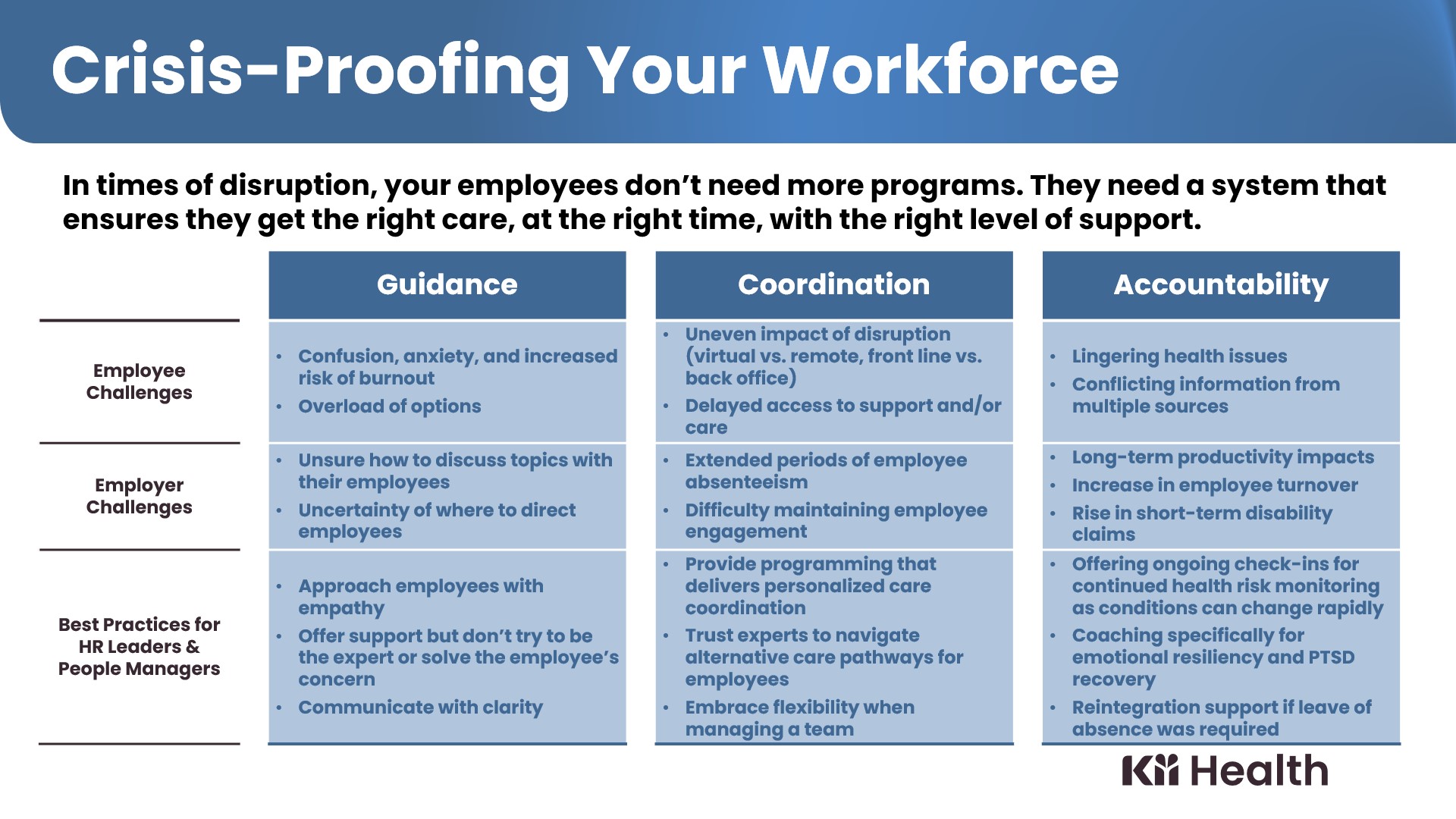
To that end, Adams argues that employers need to start with the basics, pointing to broader access to mental health support, safe spaces for conversation, managers who know how to respond with empathy as well as clear communication that reinforces inclusion while limiting information overload. But she also emphasized that listing those priorities is the easy part. What actually matters is how employers put them into practice, she said.
Courtesy of Kii Health
Adams identifies mental health as the central issue for employers navigating the fallout of the conflict, and she sees it playing out across three distinct groups in the workplace: employees with family ties or heritage connected to the region, those with no direct link who are nonetheless gripped by fear and indecision, and those with friends in the affected area who are unsure how to respond.
In her view, the organizations handling this best are moving away from passive, one-off support and toward guided models with clear ownership, escalation pathways, and managers who are prepared to respond in a more human way. She sees more value in a longitudinal coaching approach, where an employee raises a concern and is then guided through a tailored care pathway over time, rather than being left to sort through disconnected benefit options on their own.
Meanwhile, support can’t be built around the conflict itself so much as around the employee's individual circumstances, added Adams, noting that one worker may be worried about family overseas, another may feel unsafe closer to home, and another may simply be overwhelmed by constant exposure to the news.
That’s why she believes employers need outside resources that can assess each person properly and connect them to the most relevant help, whether that is counselling, physical care, or culturally specific peer support.
She’s also cautious and skeptical of blanket responses because they flatten very different experiences into a single corporate message. For her, the lesson from COVID is that employers often miss the mark when they treat everyone as though they are affected in the same way. Even employees who appear physically removed from a crisis can still be dealing with isolation, fear, and stress that later show up as workplace accommodation issues.
She pointed to one employer running "listening forums" - safe spaces where employees can speak openly about what they are feeling - as a model worth noting, particularly for global companies with staff in multiple countries. But Adams is careful to note what happens between employees as conflicts overseas can fuel division internally. To that end, she believes organizations should treat this moment as an opportunity to build skills around recognizing distress and managing difficult conversations, rather than centering the response on the war itself.
She frames cultural sensitivity and inclusion as the hardest piece of the puzzle.
"We talk about inclusivity and diversity but how do we operationalize that?" she noted, adding employers need to remind teams that employees are not stand-ins for governments or conflicts, while also finding ways to support affected communities without drawing unwanted attention to individuals.
Adams believes there’s also a gap between episodic stress and full disability leave and as a result, too many employees fall into that middle ground without adequate support.
"I think that that in-between place is where we've seen a ton of success, where employers are actually engaging with coaches who can help mental and physical health and provide access to resources that are culturally sensitive, but also mental and physically sensitive," she said, adding that shift toward holistic, personalized care represents a fundamentally different approach from simply pointing employees toward an EAP or telemedicine portal.
While Adams supports flexibility, she pushes back on the idea that paid leave should be the default response, underscoring employers need to define what leave means clearly and apply it consistently, warning that inconsistency is what leads organizations into trouble with workplace accommodations.
After all, for most employees dealing with conflict-related stress and anxiety, staying in the workplace with proper external support is a better path than stepping away from it, she argues.
"I think you're better to try and get people to stay in the workplace and get the necessary support outside the workplace to help them, then isolate them and create more isolation and more need to be not part of a community," she said. “We're better to teach the person how to have the workplace as part of your therapy than to teach them to be out of the workplace, where there's socialization, inclusion and some normality in life.”


