
Why the skill set of the future is less about execution and more about taste and judgment
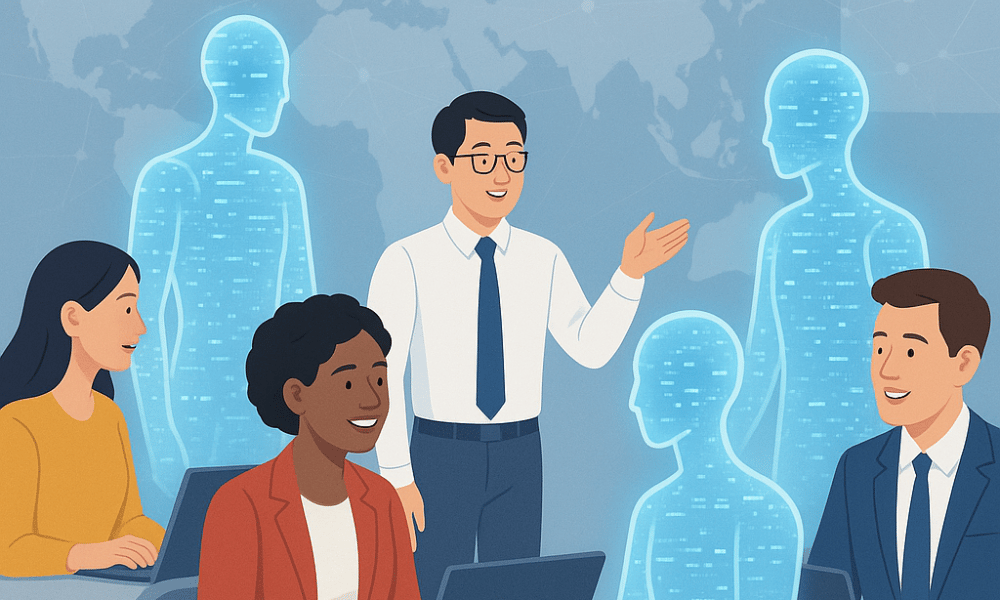
As employers struggle to fill key roles, a new generation of artificial intelligence tools is offering a different answer to the talent crunch: instead of hiring more people, use AI to make existing staff dramatically more capable via AI agents.
Two recent launches - OpenAI’s Frontier platform for building “AI co‑workers” and Anthropic’s long‑running Claude Code and Cowork agents - point to how quickly this shift is arriving inside workplaces. Together, they sketch a future in which most digital work is orchestrated by people but executed by fleets of software agents that rarely log off.
OpenAI’s new Frontier platform lets organisations design, deploy and manage AI agents that can draw on company data and perform tasks such as working with files, querying business systems and running code. These agents can connect to tools like customer relationship management platforms or collaboration apps, and act as a kind of digital colleague that can be directed toward specific goals.
Fidji Simo, OpenAI’s CEO of applications, has described these systems as “AI co‑workers” that collaborate with humans and coexist alongside agents from other vendors. She told reporters that “by the end of the year, most digital work in leading enterprises will be directed by people and executed by fleets of agents. This is already true for coding, and it’s going to happen for many other areas, too.”
Anthropic is pushing in a complementary direction. Its Claude Code and Cowork tools are examples of “long‑running” AI agents - systems that do not just answer a prompt and stop, but can keep working in the background, maintain context over time and pursue multi‑step objectives. Instead of a chat exchange, a user can point Claude at a folder of files, set an objective such as synthesising research or extracting data, and let the agent carry the work through.
Scott White, Anthropic’s head of product for enterprise, has explained that these agents can operate with “long‑horizon” thinking. A reasoning model is paired with a technical “harness” that can connect to real systems, execute code and manage workflows. The result is an assistant that can autonomously move a project forward over hours or days, while employees check in and course‑correct.
For employers grappling with talent shortages - in HR, finance, legal, analytics, customer support and more - these tools change the basic equation. Instead of treating headcount as the only way to scale output, leaders can start thinking about how to scale the capability of the people they already have.
In interviews about these systems, White has said that work is changing at three levels: individuals, workflows and business models. On an individual level, professionals can take on more complex work because AI takes over many of the rote tasks that previously filled their days. Product managers, for example, are already using agents to perform data‑science tasks that once required dedicated specialists.
At the workflow level, companies are tearing down long, sequential processes in areas such as marketing, compliance and product development. The near‑instant combination of internal data, external research and customer feedback can compress weeks of analysis into minutes of execution. That has clear implications for HR teams under pressure to deliver new policies, learning paths or workforce plans with fewer people and less time.
The third level - business models - may be the most significant for HR leaders thinking about the future of work, according to a report in the Wall Street Journal. If AI makes it far easier to test and launch new products or services, organisations can move into adjacent markets without building large new departments first. That can reduce the urgency of some hiring and shift HR’s focus toward developing adaptable, cross‑functional talent that can work effectively with agents.
Other leaders stress that AI’s value is less about replacing professionals and more about enabling them. Jeff Stibel, chief executive of LegalZoom, has said that AI makes it easier to start a business and that “AI provides the insight, but LegalZoom provides the trusted solution.” For HR, that distinction is important: AI can surface patterns in engagement data or suggest wording for policies, but employees will still look to human leaders for judgement, context and trust.
The architecture behind long‑running agents also alters which skills are most valuable on a team. Alex Salazar, co‑founder of AI startup Arcade.dev, has described how developers used to hand‑craft prompts such as “you are an accounting agent; here is the enterprise resource planning tool.” Now, users can assign higher‑level goals like “check depreciation schedules,” and the agent will “dynamically decide which skills and tools it needs to solve the problem, iterates on the plan, and executes it without rigid preprogramming.”
Salazar argues that this “shifts the nature of work from creation to editing.” Junior staff who are comfortable supervising agents, reviewing drafts and making judgement calls may outperform more experienced colleagues who insist on doing all the “grunt work” manually. For HR leaders, that raises questions about how to revise competency models, performance criteria and career paths in a world where taste and judgement matter more than typing speed or familiarity with legacy systems.
These changes will not be painless. Investor anxiety over the impact of AI on traditional software businesses has already contributed to sharp market swings. The same underlying concern will appear inside organisations as employees worry about the future of entry‑level roles, outsourcing and internal job security.
For employers, the response cannot be to ignore the technology in the hope that it will prove to be a passing fad. The companies already experimenting with long‑running agents and AI co‑workers are redesigning jobs and workflows now. They are asking which parts of a role truly require human empathy, negotiation, ethics or creativity, and which can be handed to an agent that does not get tired and can monitor dozens of systems at once.
In practical terms, HR professionals facing talent shortages can start small. One approach is to identify overworked teams - such as recruitment, payroll or learning and development - and pilot agents that handle repetitive digital tasks: formatting job descriptions, compiling interview feedback, preparing standard employment letters or summarising policy changes for different audiences. Rather than replacing roles outright, the aim is to give each person an always‑on assistant.
At the same time, organisations will need a deliberate strategy for upskilling. As one technology leader has argued, the skill set of the future is not “syntax or rote creation, but taste and judgment.” That suggests investing in training that helps employees learn how to define clear objectives for agents, review outputs critically and understand when to override or escalate.
The arrival of platforms like Frontier and long‑running systems such as Claude Code and Cowork highlights that the debate about AI and jobs is shifting from “if” to “how.” For HR leaders coping with persistent vacancies and shrinking applicant pools, the opportunity is to move from a model of hiring more people to one of building more capable teams – where every employee, regardless of level, has access to powerful digital colleagues that extend what they can achieve in a day.


